
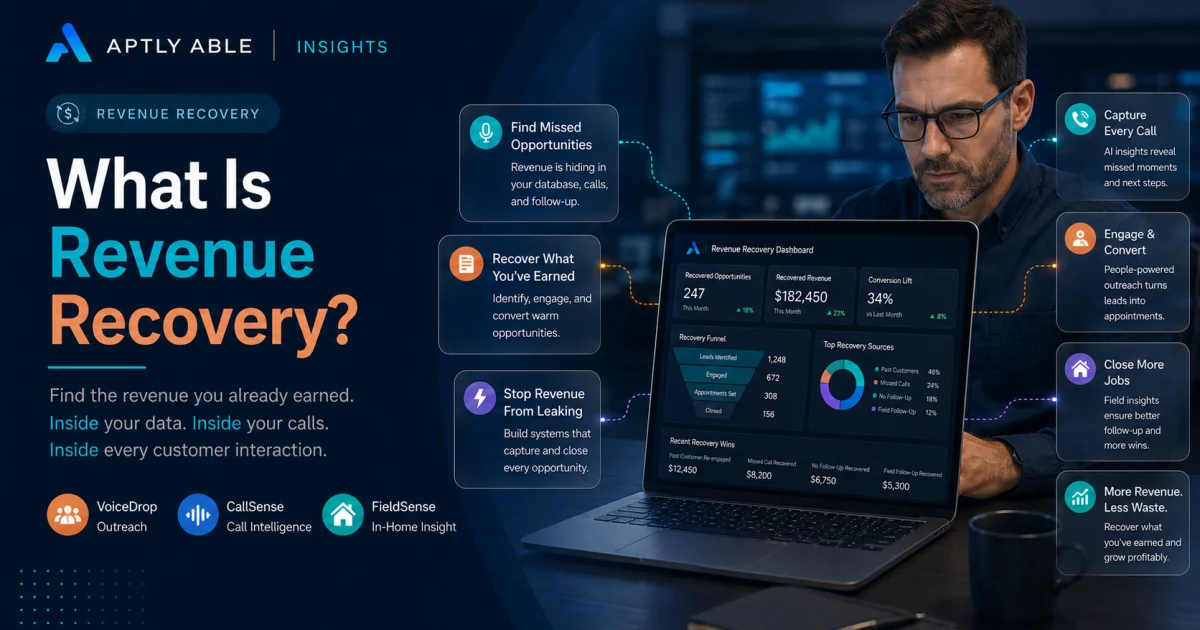
What Revenue Recovery Actually Means
Most businesses, when revenue falls short of where it should be, reach for the same answer. More leads. More ad spend. A new marketing push. Another lead vendor.
Sometimes that is exactly the right move. But more often than not, the revenue a business is looking for is not hiding somewhere outside the company. It is hiding inside it.
That is the idea behind revenue recovery.
Revenue recovery is the process of finding and converting the opportunities that are already inside your business but have not turned into closed revenue yet.
These are not bad leads. They are not hopeless situations. They are warm opportunities that got dropped somewhere along the way, usually not because anyone made a bad decision, but because there was no system in place to catch them.
The customer who called and did not get followed up with. The estimate that went out and never got a second call. The field appointment that ran well but the follow-through fell apart afterward. The past customer who has not heard from the business in two years, even though they would almost certainly book again if someone reached out.
Every one of those is a revenue opportunity the business already earned. It just needs someone to go get it.
At aptlyable.com, we describe this plainly: most companies already have revenue hiding in customer lists, old bids, inactive leads, missed calls, weak follow-up, and under-coached field appointments. The work of revenue recovery is surfacing it, acting on it, and building the process that stops it from leaking in the first place.
Where Revenue Goes Missing
After working with home-service companies, automotive dealerships, RV businesses, and other appointment-driven operations, the same pattern shows up in the same three places consistently.
The first is the customer database. Most businesses are sitting on hundreds or thousands of past customers, old bids, and warm contacts that never get worked in any systematic way. These are not cold leads. They are people who already said yes to the business at some point. They already showed buying intent. The hardest part of any sale, getting someone to engage in the first place, is already done. They are just untouched.
The second is the phones. Calls come in every day, and not all of them convert. Some get mishandled. Some do not get followed up on. Some reps miss the moment when a customer was clearly ready to book. Without real visibility into what is actually happening on those calls, managers are working from gut feelings and booking rates rather than from what is really going on in the conversations. The result is coaching that is too general to change anything specific.
The third is the field appointment. A tech or comfort advisor runs the visit, delivers a great experience, gives a quote, and the customer says they want to think about it. If there is no clear follow-up process after that visit, and no visibility into what actually happened in the home, the opportunity quietly disappears. Not because the customer was not interested. Because nobody closed the loop.
These are not small problems. For a business doing several million dollars a year, the combined impact of those three gaps can be significant. And because none of them show up as a single obvious failure, they tend to go unaddressed for a long time.
How Revenue Recovery Works
Revenue recovery is not a single tactic or a single tool. It is a systematic approach to closing the gaps where revenue leaks out across the full customer journey.
At Aptly Able, we do this through three connected solutions that follow the lead journey from the first contact all the way through to the closed deal.
VoiceDrop is people-powered outreach for existing customers and leads. It turns existing databases into warmer appointment opportunities through live outreach, real person follow-up, and live call transfers. When a business has a list of past customers, old bids, or inactive leads that are not being worked, VoiceDrop makes sure those contacts hear from someone. The second VoiceDrop campaign we ran for one HVAC company generated 67 leads in two weeks, with anticipated sales well over $100,000. Not from new ad spend. From a database the company already owned.
CallSense is AI-powered call intelligence that gives managers daily visibility into what is happening on the phones. It reviews incoming calls to surface missed opportunities, identify weak follow-up, and flag conversations that can still be recovered. Instead of stopping at call summaries, CallSense gives managers something they can act on. Daily reporting helps teams recover what can still be saved. Monthly reporting shows the patterns that keep showing up so coaching gets more specific and more effective over time. One service GM we work with put it this way: they finally had proof to make the changes they had been chasing for years.
FieldSense brings visibility to the in-home appointment, which is one of the least captured parts of the sales process. It helps document what was discussed, what the customer responded to, what was promised, and what needs to happen next. Reps get better notes and better follow-through. Managers get a clearer picture of what actually happened in the home so coaching is based on reality rather than memory or guesswork. For businesses where booked appointments are not converting at the rate they should, FieldSense is where the answer usually lives.
Together, these three solutions connect the full recovery path. VoiceDrop recovers unworked customers and old leads. CallSense shows which phone opportunities were won, lost, or still recoverable. FieldSense connects booked appointments to field outcomes and coaching needs. The result is a practical system for finding the leak, recovering the opportunity, and improving the process that created it.
Where to Start
One of the things we hear from business owners and managers is that they are not sure where to begin. Should they focus on the database first? The phones? The field?
The answer is always the same. Start where the revenue is being lost.
Not every business has the same gap. An HVAC company coming out of peak season may have dozens of unsold estimates sitting in the CRM that nobody has followed up on. A plumbing company may have strong field performance but be losing deals on the phones before appointments ever get set. An automotive dealer may have a solid call process but no visibility into what is happening after the appointment.
The starting point is different for every business. That is what the free 15-minute Revenue Recovery Audit is designed to figure out. In a short, focused conversation, we look at your database, your call conversion, and your field performance to identify where the biggest opportunity is. From there, the path forward is clear.
You do not have to change everything at once. Start where the gap is biggest. Prove the value. Expand from there.
If you are ready to find out how much revenue is already sitting inside your business, that is exactly what we are here to help with.
Start at aptlyable.com/revenue-recovery-audit.
Revenue Recovery FAQs
What is revenue recovery?
Revenue recovery is the process of finding and converting opportunities already inside a business that have not yet turned into closed revenue. Those opportunities may include past customers, old estimates, inactive leads, missed calls, weak follow-up, and unclosed field appointments.
Where does revenue usually go missing?
Revenue commonly goes missing in three places: customer databases that are not worked systematically, phone calls where booking or follow-up opportunities are missed, and field appointments where the next step is unclear or follow-through breaks down.
How does the revenue recovery process work?
The process starts by identifying the largest leak in the customer journey. A business then acts on recoverable opportunities and improves the underlying follow-up, coaching, or operational process so the same revenue does not keep leaking.
Do businesses always need more leads to grow revenue?
No. New leads may help, but many businesses can first recover more value from opportunities they already earned, including past customers, old bids, missed calls, and appointments that did not receive consistent follow-up.
How does Aptly Able support revenue recovery?
Aptly Able connects three parts of the recovery path: VoiceDrop re-engages past customers and inactive leads, CallSense surfaces missed phone opportunities and coaching needs, and FieldSense improves visibility and follow-through after field appointments.
Where should a business start with revenue recovery?
Start where the largest revenue gap exists. Aptly Able's free 15-minute Revenue Recovery Audit reviews database, call conversion, and field performance to identify the best first step.
Recommended next reads
Related Aptly Able resources
- HVAC Revenue Recovery See how the revenue recovery process applies specifically to HVAC customer lists, estimates, calls, and appointments.
- Revenue Recovery Audit Identify whether your biggest missed-revenue opportunity is in the database, on the phones, or in the field.
- VoiceDrop Turn past customers, old bids, and inactive leads into warmer appointment opportunities through live outreach.
- CallSense Use AI-powered call intelligence to surface missed opportunities, weak follow-up, and actionable coaching needs.
- FieldSense Capture what happened during field appointments so teams can improve follow-through, coaching, and conversion.