
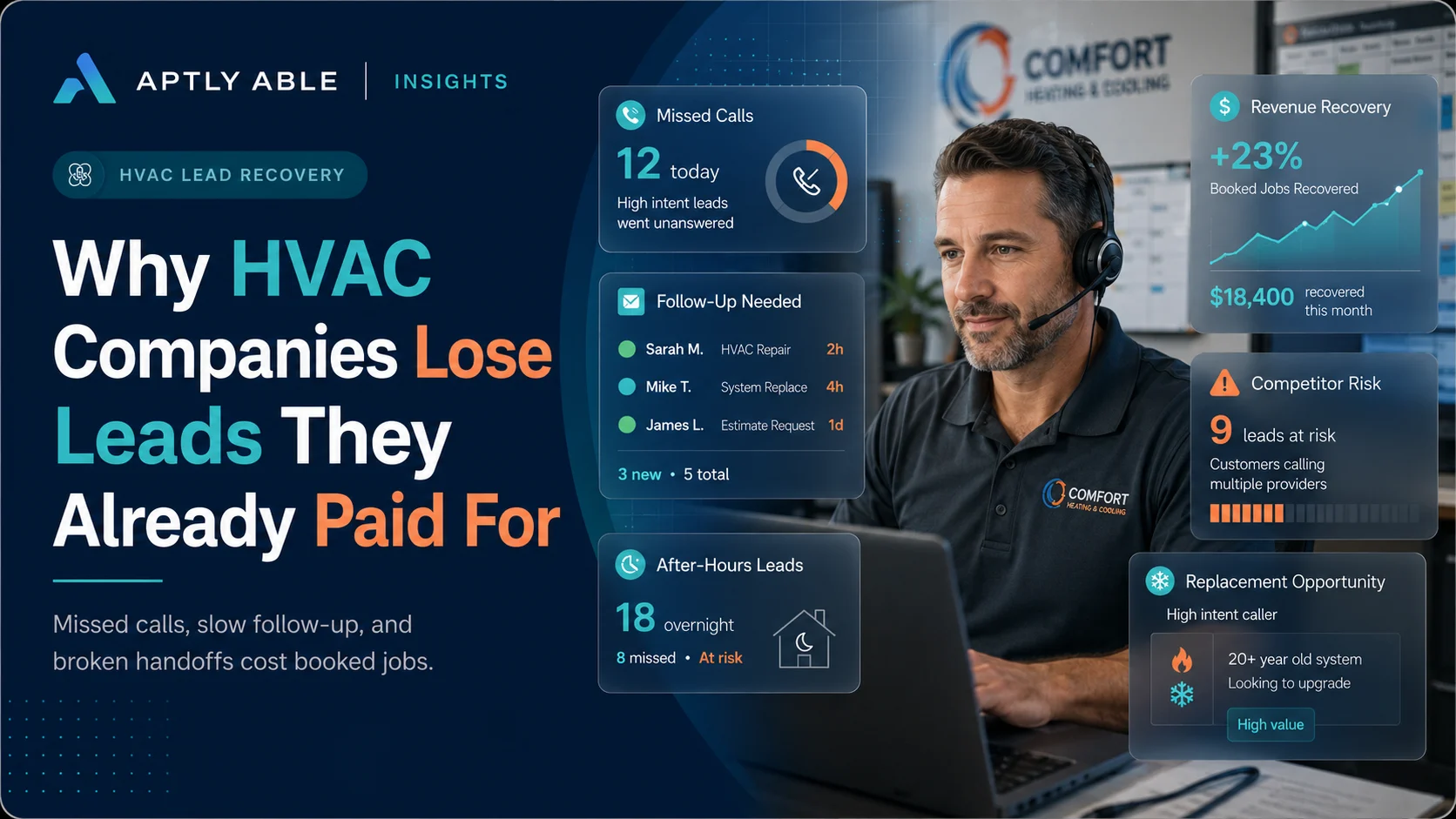
Most HVAC Companies Think They Need More Leads
Most HVAC companies think they need more leads.
More Google ads. More Local Services Ads. More SEO. More postcards. More referral partners. More calls coming in.
Sometimes that is true.
But a lot of HVAC companies do not actually have a lead problem. They have a lead handling problem.
That distinction matters because a lead problem is expensive. A lead handling problem is usually much easier to fix, and it can create revenue a lot faster than simply spending more money on marketing.
If you own or manage an HVAC company, the first question should not be, "How do we get more leads?"
The first question should be, "What is happening to the leads we already have?"
Because in a lot of companies, the answer is uncomfortable.
Customers are calling. Some are not getting answered. Some are getting answered too slowly. Some are asking good buying questions and not getting a clear next step. Some are being told someone will call them back, and then nobody does. Some are ready to book, but the conversation does not get moved to an appointment.
And when that happens, the customer usually does not sit around waiting.
They call the next HVAC company.
That is how revenue leaks out of the business.
Why HVAC Customers Call Competitors
HVAC is not like a casual purchase where the customer takes weeks to think it over.
When someone's air conditioner goes out in July or their furnace stops working in January, they usually want help now. They are not browsing for fun. They have a problem, and they want someone to solve it.
That means speed matters.
If they call your company and do not get a clear answer, they are probably not going to wait very long. If they leave a voicemail and do not hear back quickly, they are probably calling someone else. If your CSR sounds unsure, if scheduling feels complicated, or if the customer does not understand what happens next, they may keep shopping even after they talked to you.
That does not always mean your team did something terrible.
Most missed opportunities are not intentional.
They happen because the phones are busy. The CSR is juggling multiple calls. The dispatcher is trying to keep the board organized. The manager is dealing with a service issue. The sales team is following up on estimates. Everyone is moving fast, and things fall through the cracks.
The problem is that customers do not see the chaos inside the business.
They only see whether they got helped.
Missed HVAC Leads Are Not Always Missed Calls
When people hear "missed lead," they usually think of a call that was not answered.
That is one type of missed lead, but it is not the only one.
An HVAC company can answer the phone and still miss the opportunity.
A customer might ask about replacing an old system, but the call gets treated like a basic service question.
A homeowner might ask about financing, but the CSR does not know how to move that conversation forward.
A customer might say they need to talk to their spouse, and nobody follows up.
A caller might ask for a quote, but the team does not create urgency around booking an appointment.
A customer might leave a voicemail after hours, and by the time someone calls back the next morning, they already booked with someone else.
That is why the real issue is not just missed calls.
It is missed intent.
It is missed urgency.
It is missed follow-up.
It is missed revenue that was already inside the business.
The Most Common Places HVAC Leads Get Lost
In most HVAC companies, leads get lost in a few predictable places.
- Calls are not answered during peak demand.
- After-hours customers need help, but nobody captures the opportunity.
- Voicemails are not returned fast enough.
- A CSR does not recognize buying intent.
- The customer is interested but is not asked to book.
- Follow-up is promised but not completed.
- Estimates are sent but nobody follows up with a strong next step.
- The manager only sees the end result, not the conversation that caused it.
That last one is important.
A lot of owners and managers look at the numbers and know something is off. They know marketing is expensive. They know calls are coming in. They know booked appointments are not where they should be.
But they do not know exactly where the breakdown is happening.
Is it the lead source?
Is it the call handling?
Is it pricing?
Is it scheduling?
Is it follow-up?
Is it the technician or comfort advisor in the home?
Without visibility, the company is guessing.
And guessing is an expensive way to run a business.
More Leads Will Not Fix a Broken Follow-Up Process
This is where a lot of HVAC companies waste money.
They see that revenue is not where they want it to be, so they buy more leads.
But if the team is already missing opportunities, more leads may just create more missed opportunities.
That is not growth. That is leakage.
If a company is spending money to make the phone ring, then every call has value. Every missed call, weak call, poor handoff, or forgotten follow-up has a cost.
The mistake is assuming that marketing is the only growth lever.
Marketing matters. Lead generation matters. Local search matters. Reviews matter. Ads matter.
But lead response and lead recovery matter too.
If two HVAC companies get the same number of calls, the one that answers faster, follows up better, books more consistently, and learns from missed opportunities is going to win more revenue from the same marketing spend.
That company does not just have better marketing.
It has a better system.
How Fast Should an HVAC Company Respond to a Lead?
The simple answer is: as fast as possible.
But the better answer is: fast enough that the customer does not feel the need to call someone else.
HVAC customers are often dealing with discomfort, urgency, and uncertainty. They may not know what is wrong. They may be worried about price. They may be frustrated because the system failed at the worst possible time.
A fast response gives the customer confidence.
A slow response creates doubt.
That does not mean every HVAC company needs a massive call center. It means the company needs a reliable system for capturing calls, identifying urgent opportunities, and making sure follow-up actually happens.
A missed lead recovery process should answer a few basic questions every day:
- Who called and did not book?
- Who showed buying intent?
- Who asked about replacement, financing, pricing, availability, or scheduling?
- Who was promised a follow-up?
- Who needs to be called back today?
- Which calls can still be saved?
Those questions matter because some missed leads are still recoverable.
But they do not stay recoverable forever.
How to Know If Your HVAC Business Has a Lead Problem or a Lead Handling Problem
A lead problem means not enough qualified people are contacting the business.
A lead handling problem means qualified people are contacting the business, but too many of them are not becoming booked appointments or closed jobs.
Those are very different problems.
If the phone is not ringing, you may need better marketing.
If the phone is ringing but appointments are not getting booked, you need to look at the calls.
If appointments are getting booked but jobs are not closing, you need to look at the field process.
If estimates are being given but not followed up on, you need to look at your sales follow-up.
If customers are asking the same questions over and over, you may need better training, scripts, website content, or pricing communication.
The point is not to blame the team.
The point is to find the bottleneck.
Most HVAC teams are working hard. The issue is that they are often working without enough visibility.
Managers hear a few calls, review a few situations, and rely on memory or reports after the fact.
That is not enough anymore.
You need to know what is actually happening across the full lead journey.
What a Good HVAC Lead Recovery System Should Do
A good HVAC lead recovery system does not need to be complicated.
It should help you see what got missed and what needs to happen next.
At a minimum, it should identify:
- Missed calls.
- Voicemails that need response.
- Calls where the customer showed buying intent but did not book.
- Service calls that may actually be replacement opportunities.
- Customers who asked about pricing or financing.
- Calls where follow-up was promised.
- Appointments that were not scheduled.
- Estimates that need another touch.
- Patterns by CSR, campaign, call type, season, or service category.
The goal is not to create more busywork.
The goal is to create clarity.
Managers should not have to manually listen to hundreds of calls to figure out where revenue is leaking. CSRs should not have to rely on memory when the phones are busy. Owners should not have to guess whether the issue is marketing, call handling, follow-up, or sales process.
The system should surface the opportunities that matter.
Then people can act on them.
AI Can Help, But Only If It Is Focused on the Right Problem
A lot of companies are talking about AI right now.
But for HVAC companies, AI is only useful if it solves a real operational problem.
The point is not to have AI for the sake of AI.
The point is to use AI to find the calls, conversations, and follow-ups that humans do not have time to manually review.
AI can help review every call.
It can summarize what happened.
It can identify customer intent.
It can flag missed opportunities.
It can show where follow-up is needed.
It can help managers coach CSRs and sales teams.
It can help ownership see where revenue is leaking.
But AI should not replace the human side of the business.
HVAC is still a trust business.
Customers want to know someone is going to show up. They want clear communication. They want confidence. They want to feel like they are dealing with a company that knows what it is doing.
AI should help your team do that better.
It should remove noise, surface the right information, and help people act faster.
The Real Question Is Not "How Do We Get More HVAC Leads?"
More leads can help.
But more leads are not always the first answer.
The better question is:
"How much revenue are we already missing from the leads we have?"
If you do not know the answer, that is the first problem to solve.
Because there may be money sitting in your existing call volume, your existing customer database, your old estimates, your missed follow-ups, and your unbooked conversations.
Before you spend more money chasing new leads, look at the ones already coming in.
Look at the calls that did not book.
Look at the customers who asked good questions but never got moved forward.
Look at the callbacks that slipped.
Look at the after-hours calls.
Look at the replacement opportunities hidden inside service calls.
That is where a lot of HVAC companies can recover revenue quickly.
Where Aptly Able Fits
At Aptly Able, this is exactly the kind of problem we care about.
We help companies find missed opportunities in the lead journey and turn more of what they already have into booked work.
VoiceDrop helps create warmer leads from the customer database a company already owns.
CallSense helps review phone conversations, identify missed opportunities, flag broken follow-up, and show managers what needs attention.
FieldSense helps bring visibility into what happens in the home, so appointments can turn into better notes, better coaching, and more closed deals.
The simple way to think about it is this:
If the database is the biggest opportunity, start there.
If calls are where revenue is being missed, start there.
If appointments are being run but not closed, start there.
The question is not always, "How do we get more leads?"
The better question is, "Where are we losing the most revenue in the lead journey right now?"
Start there.
Fix that.
Then scale.
Because for a lot of HVAC companies, the next big revenue opportunity is not more leads.
It is recovering more from the leads they already paid for.
Frequently Asked Questions
Why do HVAC companies lose leads they already paid for?
HVAC companies often lose paid leads because calls are missed, callbacks are slow, buying intent is not recognized, customers are not asked to book, or promised follow-up never happens.
Do HVAC companies need more leads or better lead handling?
If qualified people are contacting the business but appointments are not getting booked, the company likely has a lead handling problem before it has a lead volume problem.
How fast should an HVAC company respond to a lead?
An HVAC company should respond fast enough that the customer does not feel the need to call another contractor. Urgent HVAC customers usually want help now, especially during heating and cooling emergencies.
What is HVAC lead recovery?
HVAC lead recovery is the process of finding missed calls, unbooked conversations, old estimates, inactive customers, and broken follow-up so the company can recover revenue from opportunities it already generated.
Recommended next reads
Related Aptly Able resources
- HVAC Revenue Recovery See the commercial HVAC recovery system for customer lists, estimates, phone calls, and field appointments.
- HVAC Revenue Recovery Audit Request an HVAC-specific audit to find missed revenue in old estimates, calls, follow-up gaps, and service appointments.
- CallSense Use AI call analysis to find missed HVAC phone opportunities, weak call handling, and follow-up that needs action.
- VoiceDrop Turn existing customer databases, inactive leads, and old estimates into warmer outreach opportunities.
- FieldSense See what happens after the call so HVAC appointments, recommendations, and estimates do not disappear after the visit.
- Missed Call Recovery Learn how high-intent calls can be identified, prioritized, and recovered before the customer moves on.
- Database Reactivation Recover opportunity from customers, old bids, and inactive leads already inside the business.