
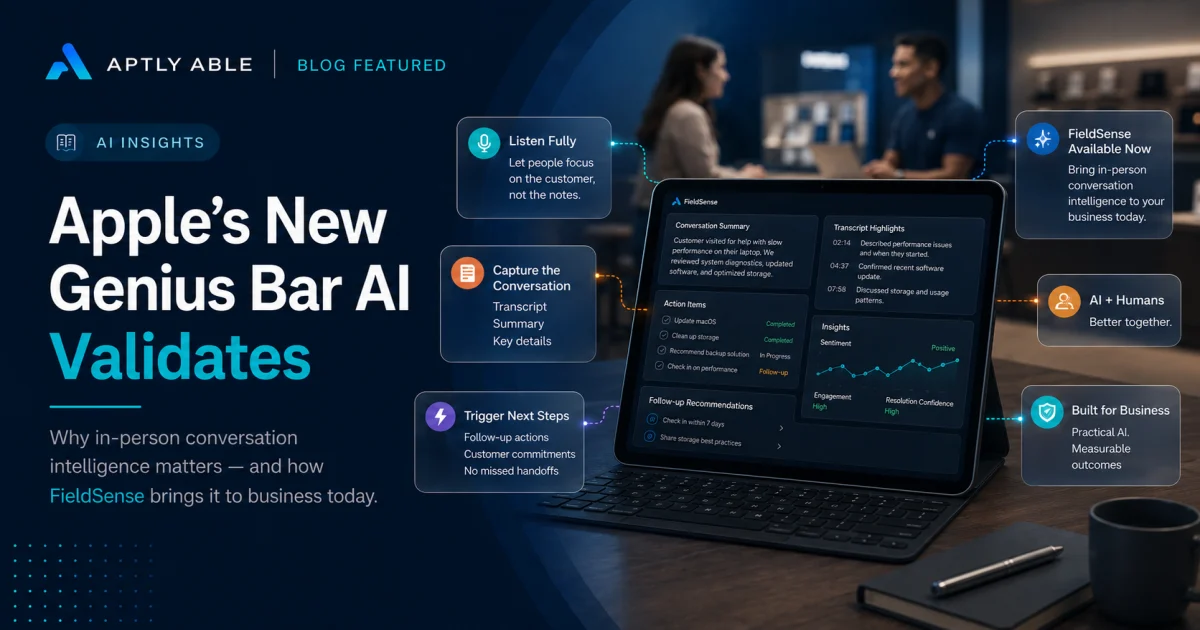
Apple’s Experiment Is Bigger Than Note-Taking
Apple is reportedly testing a new AI-powered feature inside its retail stores called Genius Bar Live Notes. The idea is simple: with a customer’s permission, an employee can use an iPad to record a Genius Bar appointment, generate a transcript, and create a written summary of what was discussed.
Apple is not presenting this as a customer-facing artificial intelligence product. The tool is designed for employees. Its purpose is to reduce note-taking, improve the accuracy of service records, and allow Genius Bar employees to focus more completely on the person sitting in front of them.
That may sound like a small operational improvement, but it represents something much larger.
Apple’s experiment validates an idea we have believed for a long time: some of the most valuable business information is created during conversations that happen in person, yet most businesses have no reliable way to preserve, analyze, or learn from those conversations.
The Blind Spot in Business Communication
Businesses have spent years improving visibility into digital communication. Emails can be searched. Customer relationship management systems track sales activity. Phone calls can be recorded and analyzed. Support tickets create a written history of customer problems. Video meetings can be transcribed and summarized automatically.
But face-to-face conversations often disappear the moment they end.
A technician visits a customer’s home and explains a repair. A salesperson walks a prospect through a proposal. A service advisor discusses a vehicle problem. A manager has a coaching conversation with an employee. A customer raises a concern at a retail counter. In each case, valuable information is created, but very little of it is captured in a reliable way.
The employee may write a short note later. They may rely on memory. They may enter a few words into a system. Or they may not record anything at all.
That creates a major blind spot.
What Apple Is Testing
The Genius Bar Live Notes pilot appears to address this problem directly. During a Genius Bar appointment, an employee can ask the customer for permission to record the conversation. If the customer agrees, the iPad captures the discussion and creates a transcript and summary. The employee can then review the summary before it becomes part of the customer’s service record.
The AI is not making the repair decision. It is not replacing the employee. It is not taking over the customer interaction. It is handling the administrative work surrounding the conversation so the employee can be more present during it.
That distinction matters. The best business use of AI is often not replacing a person. It is helping the person pay attention, remember accurately, and follow through consistently.
Better Conversations Through Better Attention
When employees know they will need to document a conversation later, part of their attention is divided. They may take notes while the customer is speaking. They may interrupt to clarify details they missed. They may spend time typing instead of maintaining eye contact. They may mentally summarize the conversation before it is finished.
That affects the customer experience.
If AI can create an accurate transcript and useful summary, the employee can focus more fully on listening. That can lead to better questions, clearer explanations, stronger trust, and fewer misunderstandings.
The technology becomes valuable not because it makes the interaction less human, but because it gives the employee more space to be human.
The Real Value Is What Happens After the Conversation
The transcript is not the most important part. The summary is not the final product. The real value is what the business can do once the conversation becomes structured information.
A service organization can identify recurring customer problems. A sales leader can understand which objections appear most often. A manager can see whether employees are consistently explaining policies correctly. A training team can find examples of strong conversations and common mistakes. A company can discover where processes are confusing, where promises are being made, and where follow-up is breaking down.
One conversation may not reveal much. Thousands of conversations can reveal patterns the business has never been able to see before.
That is why in-person conversation intelligence is much larger than transcription. It turns conversations into operational data.
Why This Matters Beyond Apple
Apple has the resources to develop an internal tool for its retail stores, but the problem it is addressing exists in nearly every industry.
Home-service companies send technicians into homes every day. Automotive dealerships have service advisors speaking with customers at the counter. Field-sales representatives meet prospects at job sites, offices, and events. Healthcare organizations conduct consultations and intake conversations. Property managers speak with tenants and vendors. Insurance adjusters meet policyholders in the field. Managers coach employees in person.
All of these conversations contain information that affects revenue, customer satisfaction, compliance, training, and operational performance. Yet most of that information is never captured in a form the business can use.
FieldSense Was Built for This Opportunity
This is exactly the opportunity behind FieldSense.
FieldSense is designed to help businesses capture and organize important face-to-face conversations. The goal is not to record people secretly or replace human judgment. The goal is to give employees and managers a reliable way to preserve what happened, identify what matters, and make sure the right next steps occur.
A field conversation can become a summary, a list of commitments, a follow-up plan, a coaching opportunity, or an operational signal. Instead of relying on memory or incomplete notes, the business gains a clearer record of what was discussed and what needs to happen next.
The same principle that makes Apple’s Genius Bar experiment valuable applies to field sales, service calls, customer visits, and employee coaching.
From Individual Notes to Organizational Knowledge
One of the biggest problems in business is that valuable knowledge often stays trapped inside individual employees. A technician knows which customer concerns appear repeatedly. A salesperson knows which objections are becoming more common. A service advisor knows which explanations customers find confusing. A manager knows which coaching topics keep coming up.
But unless that knowledge is captured and organized, the company cannot learn from it.
Conversation intelligence changes that. It allows the business to learn from interactions that were previously invisible. It can turn individual experience into shared organizational knowledge.
That can improve training, product development, customer communication, process design, and leadership decision-making.
Privacy and Consent Must Come First
Recording in-person conversations introduces serious responsibilities. Customers and employees need to understand when recording is happening, why it is happening, how the information will be used, and how long it will be stored. Consent must be clear. Access must be controlled. Sensitive information must be protected.
Apple’s reported approach is notable because the employee asks for permission before recording begins. The customer can decline. The AI-generated summary is also reviewed by the employee before it is saved.
That is the right direction. AI should support accountability, not remove it. The person involved in the conversation should remain in control, and the business must build privacy into the workflow from the beginning.
Human-Centered AI Is the Bigger Story
A great deal of AI discussion focuses on replacement: which jobs will disappear, which tasks will be automated, and whether machines can perform work without people.
Apple’s experiment points toward a more practical and more useful future. The AI does not need to replace the Genius Bar employee. It needs to help that employee listen better, remember more accurately, document more consistently, and serve the customer more effectively.
That is the kind of AI implementation businesses should be pursuing. The technology should remove low-value friction while strengthening human performance.
In many cases, the best AI product will not be the one that eliminates the conversation. It will be the one that makes the conversation more valuable.
The Future of Conversation Intelligence Is Everywhere
Phone-call intelligence has already shown businesses how much useful information exists inside customer conversations. Meeting transcription has shown employees the value of automatic notes and summaries. The next step is extending those capabilities into the physical world.
Every in-person conversation creates signals: customer needs, buying intent, objections, commitments, questions, confusion, sentiment, and follow-up requirements. When those signals can be captured responsibly, businesses can operate with much greater clarity.
Apple may be testing this idea inside the Genius Bar, but the opportunity reaches far beyond retail support. It applies anywhere people meet customers, prospects, employees, patients, tenants, homeowners, or business partners face to face.
The future of conversation intelligence is not limited to call centers or video meetings. It is moving into stores, homes, service bays, job sites, offices, and every other place where important business conversations happen.
A Small Experiment That Validates a Large Opportunity
Genius Bar Live Notes may begin as a limited test. It may change before Apple expands it. It may remain an internal tool. But the idea behind it is important.
Businesses lose valuable information every day because important face-to-face conversations are not captured. AI can help preserve that information without distracting the employee or diminishing the human relationship.
When implemented correctly, the result is better documentation, stronger follow-up, more useful coaching, clearer customer insight, and a better experience for everyone involved.
Apple’s experiment confirms what we have believed for a long time: the next major opportunity in conversation intelligence is not simply analyzing what happens on the phone or in a video meeting. It is helping businesses understand and improve the conversations happening everywhere else.
Recommended next reads
Related Aptly Able resources
- FieldSense See how FieldSense captures, summarizes, and organizes face-to-face sales and service conversations.
- CallSense Learn how Aptly Able analyzes customer calls for coaching, customer experience, and revenue opportunities.
- AI Should Make People Better, Not Replace Them Read Aptly Able’s perspective on using AI to strengthen human performance and judgment.