
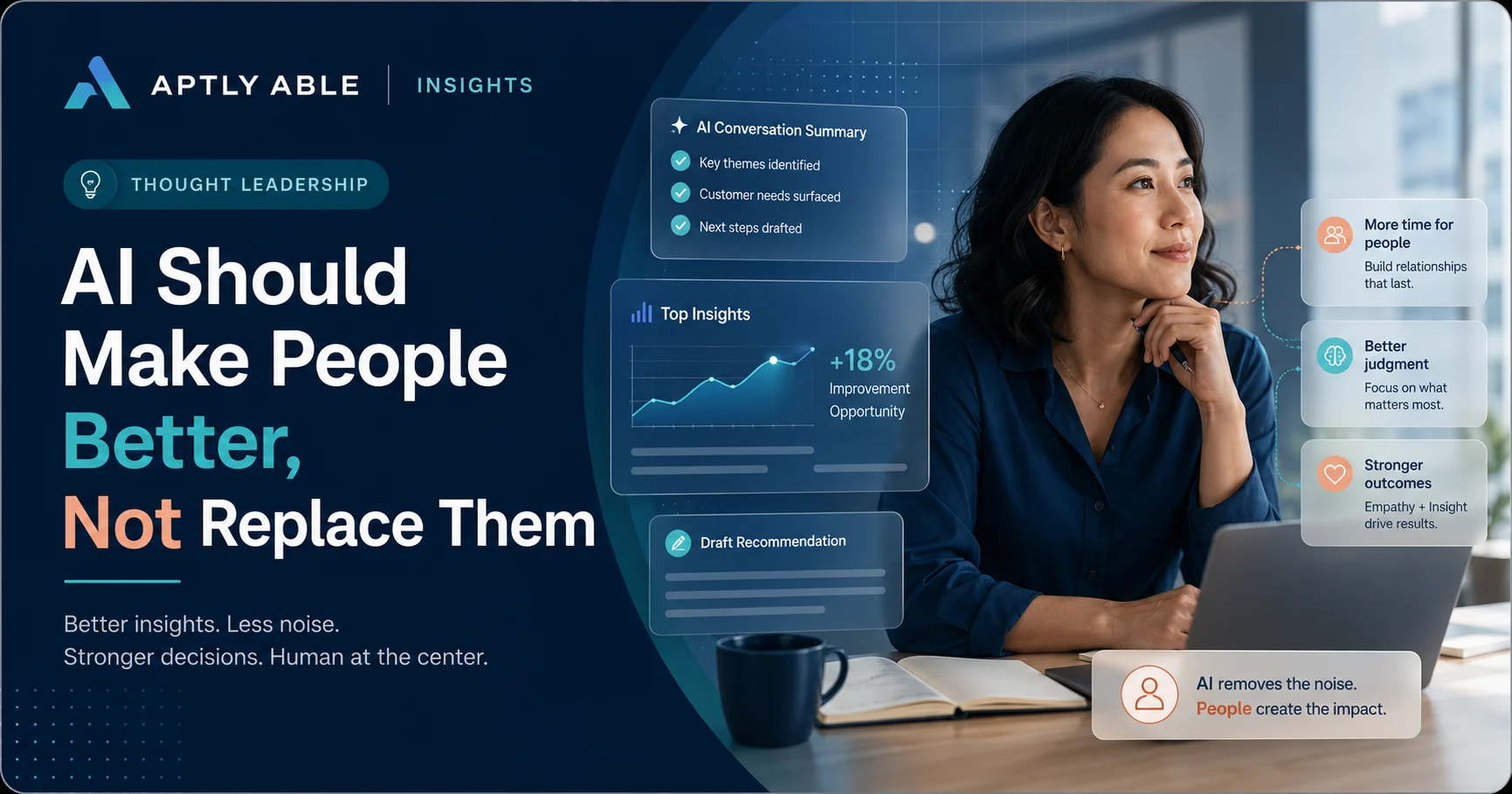
A lot of companies are looking at artificial intelligence through the wrong lens.
They are asking, "How many people can this replace?"
That question may sound efficient, but it misses the bigger opportunity. AI is not at its best when it is used as a blunt instrument to reduce headcount. AI is at its best when it is used to make people dramatically more capable.
I have been on the forefront of AI development since the very beginning, and my view is simple: AI should make people better. It should not replace them.
That distinction matters.
There are absolutely parts of work that AI should replace. It should replace repetitive tasks. It should replace manual processes that waste time. It should replace work that requires people to sift through massive amounts of information just to find the few things that matter. It should replace the parts of a job that people are not especially good at, do not enjoy, or should not have to spend their best hours doing.
But that is very different from replacing the person.
People are not at their best when they are buried in busywork. They are not at their best manually entering the same information over and over. They are not at their best trying to remember every detail from every customer conversation. They are not at their best searching through spreadsheets, call notes, emails, reports, and disconnected systems just to understand what is really happening in the business.
AI can do a lot of that work faster, more consistently, and at a scale people simply cannot match.
That does not make people less valuable. It makes their highest-value work more visible.
The real value of AI is that it allows people to focus on the things humans are actually good at: judgment, creativity, empathy, leadership, problem-solving, relationship-building, and understanding context.
AI can summarize a customer interaction. A person can understand what that interaction means.
AI can identify a pattern. A person can decide what to do about it.
AI can flag a risk. A person can weigh the consequences.
AI can recommend a next step. A person can apply judgment, experience, and accountability.
That is where AI becomes powerful. Not as a replacement for people, but as leverage for people.
A customer service representative with AI should not become less important. They should become more capable. AI can summarize customer history, surface prior issues, identify sentiment, suggest next steps, and flag when a situation needs attention. That allows the representative to spend more time listening, solving problems, and building trust.
A salesperson with AI should not become less human. They should become more prepared. AI can identify buying signals, organize notes, track follow-up, surface objections, and reveal patterns across conversations. That allows the salesperson to focus on relationships, timing, and understanding what the customer actually needs.
A manager with AI should not become more detached from the team. They should become more aware. AI can identify coaching opportunities, recurring customer complaints, process gaps, and performance trends that would otherwise be buried in day-to-day activity. That allows the manager to support people earlier and make better decisions.
This is the shift companies need to understand.
AI does not remove the need for human ability. It changes where human ability is most valuable.
Companies that use AI only to cut people may see short-term savings, but they risk losing the very things that make a business strong: customer trust, institutional knowledge, creative problem-solving, leadership development, and the ability to adapt when something does not fit neatly inside an automated process.
Companies that use AI to improve people will build stronger teams.
They will have employees who are better informed, better trained, more productive, and more engaged. They will have managers with better visibility. They will have customers who get faster answers without losing the human relationship. They will have systems that learn from the work being done instead of simply recording it after the fact.
That is the future worth building.
At Aptly Able, this principle is central to how we think about AI.
We are not interested in AI that makes companies colder, less personal, or less human. We are interested in AI that helps people do their jobs better. AI that gives leaders better insight. AI that helps teams improve. AI that turns daily work into useful information. AI that removes unnecessary friction so people can focus on the work that actually matters.
The goal should not be to replace the people who care.
The goal should be to remove the noise around them so they can do their best work.
AI is going to change every business. That part is no longer theoretical. The real question is whether companies will use it wisely.
Used poorly, AI becomes a cost-cutting tool that strips away human value.
Used properly, AI becomes a force multiplier for the people who create that value.
At Aptly Able, we believe the future belongs to companies that understand the difference.
AI should make people better.
That is the standard we are building around.
Recommended next reads
Related Aptly Able resources
- CallSense See how Aptly Able uses AI call analysis to help managers coach teams and recover missed revenue.
- What Is AI Call Analysis? Read the companion article on using AI to understand customer conversations and missed opportunities.
- Revenue Recovery Audit Find where existing calls, leads, follow-up, and appointments are leaking revenue.
Helpful external reading
- IBM just tripled its entry-level hires while everyone else fires theirs A useful companion read on companies using AI to rethink work, training, and human capability instead of treating automation as a simple replacement strategy.