
HVAC Call Booking Rate Measures What Happens After the Phone Is Answered
An HVAC company can have strong lead volume, a healthy answer rate, and a full marketing budget while still losing good opportunities on the phone. The call connected, but the customer never reached a useful next step.
HVAC call booking rate is the percentage of legitimate inbound call opportunities that become scheduled appointments. The important words are legitimate and scheduled. Vendor calls, spam, wrong numbers, existing jobs that only need a dispatch update, and calls outside the company’s service fit should not be treated like new booking opportunities.
The rate is simple. The denominator is where most reporting goes wrong.
ServiceTitan’s current dashboard documentation defines inbound call booking rate as the percentage of call leads booked into jobs. In that system, a call lead is an incoming call lasting at least 60 seconds or one marked as a lead.[3] That is a useful product definition, but every HVAC company still needs a written rule that fits its own phone system, call types, and service model.
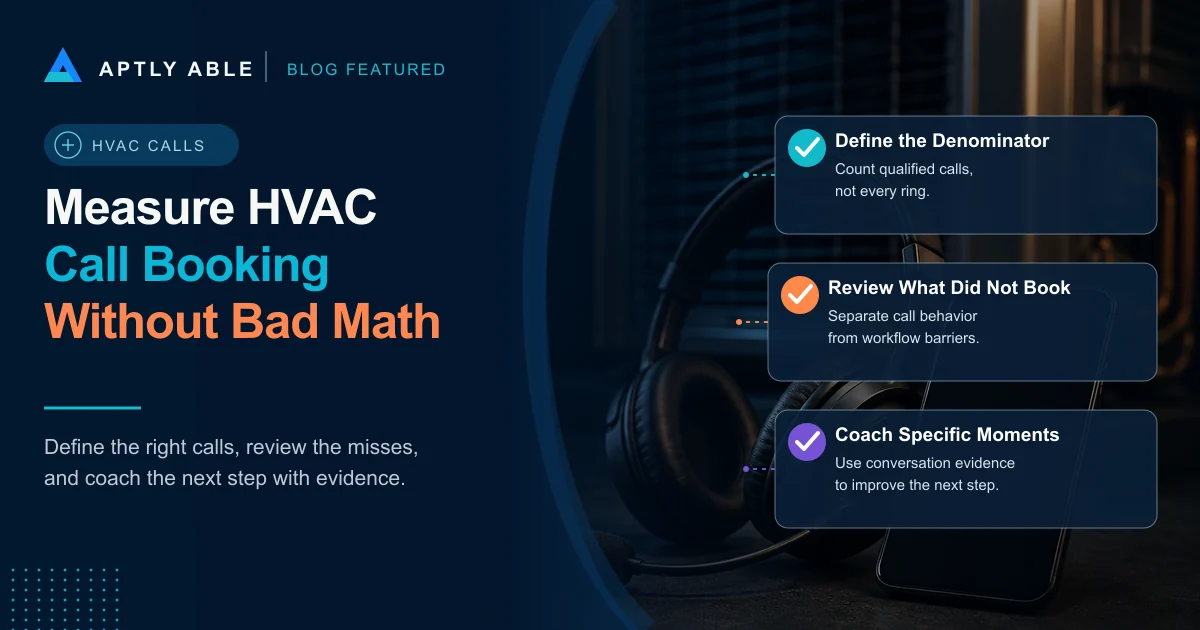
Start With a Defensible Denominator
Use this basic formula:
HVAC call booking rate = booked appointments from qualified inbound calls ÷ qualified inbound calls × 100
Do not divide booked appointments by every inbound call. That punishes the team for calls it could not reasonably book and makes comparisons unreliable.
Define a qualified inbound call before the report is built. A practical definition might require that the caller is inside the service area, wants a service the company provides, has a current or reasonably actionable need, and is not already calling about a booked job. Keep exclusions visible instead of deleting them. Managers should be able to see why a call was marked spam, non-serviceable, duplicate, existing-job support, or otherwise non-bookable.
Also decide how to handle calls that should create a different next step. A replacement inquiry may need a comfort-advisor appointment. A customer with an unresolved complaint may need service recovery. A commercial prospect may need a site visit. The right outcome is not always the same calendar event, but it should still be explicit and measurable.
Separate Answer Rate, Booking Rate, and Completed-Job Rate
These three numbers answer different questions:
- Answer rate: Did a person or approved answering process connect with the caller?
- Booking rate: Did a qualified call become a scheduled appointment or other defined next step?
- Completed-job rate: Did the booked appointment actually occur and reach a documented outcome?
A high answer rate with a low booking rate points toward call handling, availability, pricing questions, routing, or weak next-step language. A strong booking rate with poor completed-job performance points toward scheduling quality, cancellations, no-shows, dispatch, capacity, or bad-fit appointments.
Keep advertising conversions separate too. Google Ads call reporting can show details such as call duration, start time, connection status, and certain caller information, and it can count calls that reach a chosen duration as conversions.[4] A duration-based advertising conversion is useful for media optimization, but it is not proof that an HVAC appointment was booked. Reconcile advertising, phone, CRM, scheduling, and completed-job records instead of letting one platform stand in for the whole customer journey.
Do Not Copy a Benchmark Without Copying the Definition
Benchmarks can show that improvement is possible, but they are not a substitute for a clean internal baseline.
ServiceTitan reported that its June 2022 data across more than 3,000 trade businesses produced a typical call booking rate of 42%. The same report showed wide variation by business size, season, trade, and time of day; HVAC was 38% in that month, and after-hours performance was materially lower than morning performance.[1] Those figures describe a particular platform population and period. They do not automatically define what a specific HVAC company should produce today.
The useful lesson is the variation. Compare like with like inside your own business:
- New customer service calls versus existing-customer calls.
- Repair, maintenance, replacement, indoor-air-quality, and commercial requests.
- Business hours versus after hours.
- Weekdays versus weekends.
- Peak season versus shoulder season.
- Location, team, marketing source, and call taker.
A single blended percentage can hide the exact place where revenue is leaking. If after-hours calls book poorly, the answer may be coverage or scheduling authority. If one campaign produces many non-serviceable calls, the problem may be targeting. If qualified calls connect but one call type rarely books, the team may need better discovery, clearer options, or a different handoff.
Review the Calls That Did Not Book
A booking-rate dashboard tells you where to look. The conversations tell you what to fix.
Create a review queue from qualified calls that did not reach the intended next step. Include the recording or transcript, call source, call type, customer history, service area, available capacity, employee, stated objection, promised follow-up, and final disposition.
Then classify the failure point:
- The need was never clearly understood.
- Urgency, equipment, location, or decision context was missed.
- The requested service was not available in the needed window.
- A price or diagnostic-fee question ended the call.
- The employee answered questions but never asked for the appointment.
- The call needed a transfer or callback, but ownership disappeared.
- The appointment was technically booked but the information was incomplete.
- The caller was not a true opportunity and should be removed from the denominator.
This is where call scoring and booking-rate analysis work together. Booking rate shows the outcome. A call scorecard shows whether the observable behaviors were present. Neither should replace the other.
Coach One Observable Behavior at a Time
“Book more calls” is a target, not coaching.
Give the CSR the exact moment in the conversation, name the behavior that affected the outcome, and practice a better response. If discovery was weak, identify the two questions that would have clarified the need. If the customer asked about price, practice how to explain the service process without making promises the technician cannot keep. If the close was vague, practice offering a specific next step and confirming it before the call ends.
ACCA’s CSR training for HVAC contractors centers on active listening, empathy, understanding customer needs, handling objections, and helping callers book the call.[2] Those are coachable behaviors. They become more useful when managers connect them to actual calls and measure whether the new behavior changes the outcome.
Use several calls before declaring a pattern. One unusual caller is not a performance trend. Repeated breakdowns across similar calls may reveal a training gap, but they may also reveal a policy, capacity, routing, or pricing problem that the CSR cannot solve alone.
Fix the System Around the CSR
A call taker cannot book an appointment that the system makes impossible to schedule.
Before treating every unbooked call as a people problem, check whether the team has:
- Current service-area rules.
- Clear service categories and call-routing rules.
- Accurate availability and permission to offer appointment windows.
- A defined process for urgent, after-hours, and overflow calls.
- Approved explanations for diagnostic fees, memberships, financing, and next steps.
- Customer history and open-task visibility.
- A clear owner for transfers and promised callbacks.
- Outcome codes that reflect what actually happened.
ServiceTitan’s current call-metrics documentation exposes unbooked and abandoned calls with details such as call length, timestamp, number dialed, and the employee who answered, while also supporting playback, tags, and reclassification.[3] Whatever tools an HVAC company uses, the operating requirement is the same: managers need enough evidence to distinguish a missed behavior from a broken workflow.
Measure Revenue Without Inventing It
Do not multiply every unbooked call by the average ticket and call the result lost revenue. Some callers were never going to book, some booked elsewhere for reasons the team could not control, and some needs were not profitable or serviceable.
Use a more defensible revenue path:
- Count qualified inbound calls.
- Count appointments booked from those calls.
- Count appointments that ran.
- Count jobs sold or completed.
- Use recorded invoice or sold-job value.
- Track recoveries separately when an initially unbooked call later becomes a job.
This gives the company an observed funnel instead of a hypothetical pile of money. It also shows where improvement belongs. If calls book but appointments cancel, call coaching alone will not fix the leak. If appointments run but estimates stall, the next focus may be field execution or estimate follow-up.
The commercial pressure is real. CallRail’s 2026 survey of U.S. home-service businesses found that 66% named lead follow-up and conversion as a major operational challenge, 57% pointed to sales and customer-service training, and 49% cited appointment scheduling or booking.[5] The practical response is not to chase a universal benchmark. It is to make the company’s own path from ring to revenue visible.
Build a Weekly HVAC Call Booking Review
A useful weekly review can fit on one page:
- Qualified inbound calls and written denominator rules.
- Answered, abandoned, missed, and recovered calls.
- Booking rate by call type, time block, source, location, and employee.
- Appointments booked, completed, canceled, and rescheduled.
- Top reasons qualified calls did not book.
- Promised callbacks still open.
- Calls selected for coaching and the behavior being practiced.
- Workflow problems assigned to an owner and due date.
Review trends, not just rankings. Ask which call type changed, whether the denominator stayed consistent, what callers are saying, and whether the business can fulfill the appointments it is asking employees to book.
CallSense can support this work by organizing customer conversations, surfacing booking intent, finding calls that ended without a next step, and giving managers specific evidence for coaching. The purpose is not to turn every call into a grade. It is to help the team see which opportunities need action and which parts of the call process need repair.
The best HVAC call booking metric is not the most impressive percentage. It is the one the team can define, audit, explain, and improve without losing sight of the customer.
HVAC Call Booking Rate FAQs
What is a good HVAC call booking rate?
A good HVAC call booking rate is one based on a consistent qualified-call definition and improved against the company’s own comparable baseline. Trade benchmarks provide context, but call type, season, hours, capacity, service area, and denominator rules can materially change the result.
How do you calculate HVAC call booking rate?
Divide appointments booked from qualified inbound call opportunities by the total number of qualified inbound call opportunities, then multiply by 100. Document which calls qualify and preserve exclusion reasons so the rate can be audited.
What should be excluded from HVAC call booking rate?
Exclude calls that are clearly spam, wrong numbers, duplicates, existing-job status requests, outside the service area, or for services the company does not provide. Keep each exclusion visible and consistently classified.
Is call booking rate the same as answer rate?
No. Answer rate measures whether the call connected. Booking rate measures whether a qualified connected call became a scheduled appointment or other defined next step. A company can answer most calls and still lose opportunities during the conversation.
How can an HVAC company improve call booking rate?
Review qualified calls that did not book, classify the failure point, coach one observable behavior at a time, and fix workflow barriers such as unclear routing, unavailable appointment windows, weak callbacks, outdated service-area rules, or incomplete customer context.
Should Google Ads phone conversions equal booked HVAC jobs?
No. Google Ads can count calls meeting a chosen duration as conversions, while a booked job requires confirmation in the company’s scheduling or CRM system. Reconcile ad, phone, appointment, and completed-job records instead of treating call duration as a booking.
Recommended next reads
Related Aptly Able resources
- HVAC Revenue Recovery See how Aptly Able helps HVAC companies recover revenue from calls, customer databases, estimates, and field execution.
- CallSense Use AI call analysis to surface booking intent, missed opportunities, weak handoffs, and specific coaching evidence.
- Call Intelligence for Home Services Learn how home service businesses use conversation intelligence to improve call handling and follow-through.
- What Is Call Scoring? Build a fair, observable scorecard that connects call behavior to coaching and customer outcomes.
- Revenue Recovery Audit Find where phone, database, estimate, or field-execution gaps are leaving recoverable revenue behind.
Helpful external reading
- [1] ServiceTitan: Average Call Booking Rates ServiceTitan’s historical study of call-booking rates across more than 3,000 trade businesses, including variation by trade, size, season, and time of day.
- [2] ACCA: CSR Training to Book More Calls ACCA training overview covering active listening, empathy, customer needs, objections, and inbound call booking for HVAC teams.
- [3] ServiceTitan: Dashboard Call Metrics Current ServiceTitan documentation defining inbound call booking rate and the call evidence available for reviewing unbooked and abandoned calls.
- [4] Google Ads: About Call Reporting Google documentation on call reporting, forwarding numbers, call details, and duration-based phone-call conversions.
- [5] CallRail: 2026 Home Services Marketing Trends CallRail survey findings on lead follow-up, conversion, sales training, responsiveness, and appointment booking challenges in home services.