
What Call Scoring Means
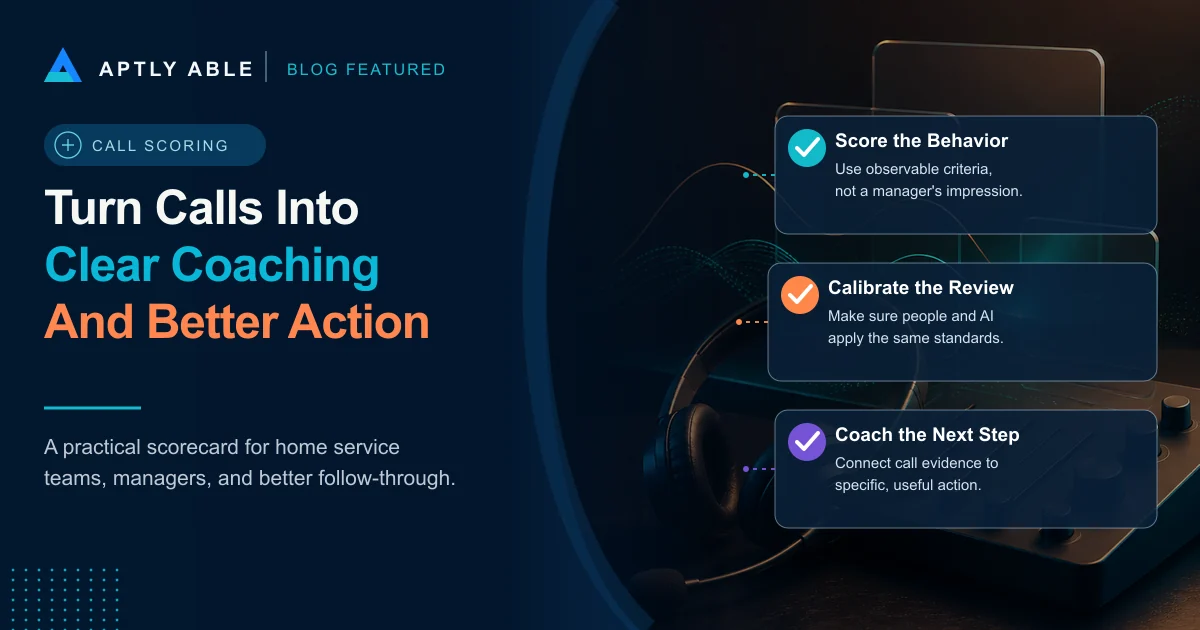
Call scoring is a structured way to evaluate what happened during a customer call. A useful scorecard looks at observable behaviors—how the call opened, whether the employee understood the need, whether the right next step was offered, and whether promised follow-up was clear—rather than relying on a manager's general impression.
For a home service business, the purpose is not to turn every conversation into a grade. It is to find the moments that affect booking, customer trust, follow-through, and coaching.
Call Scoring Is More Than a Final Number
A call score is only useful when the team can explain what produced it.
A single number such as 82 does not tell a CSR what to do differently. A strong scorecard breaks the conversation into specific behaviors. Did the employee identify the customer's need? Did they ask the questions required to schedule correctly? Did they explain the next step? Did they create a clean handoff? Did they document the promise made to the customer?
Modern conversation-analytics platforms can work from recordings and transcripts, detect categories and sentiment, and place evaluations beside call details, summaries, and quality standards.[1] That makes broader review possible, but the technology still needs a scorecard that reflects how the business actually serves customers.
The score is the summary. The evidence inside the conversation is what makes it useful.
What a Home Service Call Scorecard Should Measure
There is no universal scorecard that fits every department. A booking call, maintenance reminder, dispatch update, financing question, and upset-customer call should not be judged as if they have the same purpose.
Most home service teams can start with a small set of categories:
- Opening and ownership: Did the employee identify the company, listen, and take responsibility for helping?
- Need discovery: Did the employee understand the problem, timing, location, and relevant customer context?
- Accuracy: Was the information correct, and were required questions asked?
- Opportunity recognition: Did the employee recognize repair, replacement, maintenance, estimate, or follow-up intent?
- Next-step clarity: Was an appointment, transfer, callback, estimate review, or other action clearly defined?
- Customer experience: Was the conversation respectful, direct, and easy to follow?
- Documentation and handoff: Were notes, commitments, and ownership recorded for the next person?
- Required language: Were any company-approved disclosures or process requirements handled correctly?
Keep each category observable. ‘Showed empathy’ is vague. ‘Acknowledged the customer's concern before moving to scheduling’ is coachable.
Do Not Confuse Call Outcome With Call Quality
A booked appointment can still be a poor call. The employee may schedule the wrong service, miss an urgent condition, promise something the field team cannot deliver, or create a weak handoff.
The reverse is also true. A good call may not book. The customer may be outside the service area, may need a service the company does not provide, may be comparing future options, or may simply not be ready.
That is why the scorecard should separate behaviors from outcomes. Track whether the appointment booked, but also score whether the employee handled the conversation correctly. When those two measures are combined into one judgment, managers can reward bad habits that happened to produce a sale and punish good work that produced an honest no.
Good call scoring asks two questions: Did the team handle the call well? What happened next?
Build the Scorecard Around the Customer Journey
Start with the calls the business most needs to improve. Do not begin with fifty questions across every department.
Choose one call type, such as inbound HVAC service booking. Map the customer journey from the first greeting to the documented next step. Identify the few behaviors that protect the customer experience and the few that most often affect booking or follow-through.
Then write each question so two trained reviewers can hear the same conversation and reach the same answer. Use yes/no or clearly defined rating anchors when possible. If a reviewer has to guess what ‘excellent’ means, the employee will have to guess too.
A practical first version may contain ten to fifteen questions. Weight only the items that truly deserve more importance. Safety, required disclosures, correct scheduling, and a promised callback may deserve critical treatment. Small wording preferences usually do not.
The goal is not to make the scorecard comprehensive. It is to make it consistent enough to guide action.
Use Calibration Before You Use Rankings
Before comparing employees, calibrate the people doing the scoring.
Give several reviewers the same small set of calls. Have them score independently, then compare where and why they disagreed. The disagreement may expose a vague question, a missing exception, or a policy that supervisors interpret differently.
Rewrite the scorecard until the team can apply it consistently. Repeat calibration whenever the call type, script, promotion, dispatch rule, or service policy changes.
This step matters just as much when AI assists with scoring. NIST describes its AI Risk Management Framework as voluntary guidance for helping organizations manage AI risks and promote trustworthy and responsible development and use.[2] In a call-scoring program, that means defining the intended use, testing the output, keeping human review for disputed or high-impact decisions, and watching for patterns the system may be missing.
Automation can increase coverage. Calibration protects meaning.
Turn Scores Into Specific Coaching
A score should lead to one clear coaching conversation, not a generic message to ‘do better.’
Show the employee the exact part of the call, name the behavior, explain why it matters, and practice a better response. If the issue was weak discovery, rehearse two questions that would have revealed the customer's real need. If the issue was a vague next step, practice a close that names the owner and timing. If the handoff failed, fix both the wording on the call and the documentation that followed it.
Look for patterns across several calls before treating a behavior as a trend. One unusual conversation may need correction, but repeated gaps reveal where training, staffing, routing, policy, or tools may be creating the problem.
The manager's job is not only to identify who missed a step. It is to learn why the step keeps getting missed.
Pair Call Scoring With Revenue-Recovery Work
Call scoring becomes more valuable when it connects to the work after the call.
A connected call may contain buying intent but end without an appointment. A CSR may promise a callback that never gets assigned. A customer may mention an old estimate without anyone reopening it. A caller may need a field follow-up that disappears between the office and the technician.
CallSense helps surface those moments across customer conversations. The scorecard shows how the call was handled; revenue-recovery workflow makes sure the opportunity receives an owner and next action.
This connection also improves the scorecard. If high-scoring calls still create broken handoffs, the scorecard is missing something. If one behavior consistently appears in calls that reach a clear resolution, that behavior may deserve more coaching attention.
Do not score calls in isolation from the CRM, schedule, estimate, and follow-up outcome. The conversation is one part of the customer journey.
Common Call-Scoring Mistakes
The fastest way to lose trust in call scoring is to make it feel arbitrary.
Avoid these common mistakes:
- Using one scorecard for every call type.
- Scoring personality instead of observable behavior.
- Treating a booking as proof that every part of the call was good.
- Creating so many questions that nobody can explain the final score.
- Ranking employees before reviewers are calibrated.
- Using AI output without testing it against real conversations.
- Coaching from a number without replaying the supporting moment.
- Ignoring what happened after the call.
- Changing the scorecard without telling the team why.
A scorecard should reduce ambiguity, not create another layer of it.
A Simple 30-Day Starting Plan
In the first week, choose one call type and define the customer outcome. Draft ten to fifteen observable questions and identify any truly critical items.
In the second week, score a small shared set of calls with multiple reviewers. Compare disagreements, rewrite vague questions, and document exceptions.
In the third week, use the scorecard in coaching. Give employees the criteria, show examples, and focus each coaching session on one or two behaviors.
In the fourth week, compare scores with bookings, handoffs, callbacks, complaints, and unresolved opportunities. Look for where the scorecard explains the outcome and where it does not. Revise it before expanding to another call type.
Start small, make the criteria visible, and improve the system with the people who use it.
What Good Call Scoring Looks Like
Good call scoring is specific, fair, and connected to action.
The employee can understand why the score changed. The manager can point to the exact moment that deserves coaching. The business can see whether better call behavior leads to cleaner bookings, stronger handoffs, and fewer opportunities disappearing after the conversation.
AI can help review more calls and organize the evidence. People still need to define what good service means, test the system, coach with judgment, and own the next step.
The best scorecard does not make the team feel watched. It helps the team know what good looks like—and gives managers a practical way to help them get there.
Call Scoring FAQs
What is call scoring?
Call scoring is a structured process for evaluating observable behaviors in a customer call, such as need discovery, accuracy, opportunity recognition, next-step clarity, customer experience, and documentation.
How is AI call scoring different from manual call review?
Manual review relies on people listening to selected calls. AI-assisted scoring can organize and evaluate a broader set of conversations, but the business still needs clear criteria, calibration, validation, and human review for disputed or high-impact decisions.
What should an HVAC call scorecard include?
An HVAC call scorecard should match the call type and may include the opening, problem and urgency discovery, service-area and scheduling accuracy, opportunity recognition, required language, appointment or handoff clarity, customer experience, and documentation.
Should a booked call always receive a high score?
No. Booking is an outcome, not proof that every behavior was correct. A booked call can still contain poor discovery, inaccurate scheduling, an unsafe promise, or a weak handoff.
How many questions should a call scorecard have?
A practical first scorecard often works best with ten to fifteen observable questions. The right number is the smallest set that reliably measures the behaviors the business needs to coach.
Can call scores be used for employee discipline?
Call scores should be validated and calibrated before they influence high-impact decisions. Employees should know the criteria, have access to the supporting call evidence, and have a fair process for correcting scoring errors or missing context.
Recommended next reads
Related Aptly Able resources
- CallSense See how Aptly Able analyzes customer conversations to surface coaching needs, missed opportunities, and required follow-up.
- Call Intelligence for Home Services Learn how home service companies use conversation intelligence to improve booking, coaching, and customer follow-through.
- What Is AI Call Analysis? Understand how AI call analysis turns recordings and transcripts into searchable operational insight.
- Why Reviewing 1% of Customer Calls Is No Longer Enough See why small manual samples can miss important coaching and customer-service patterns.
- Revenue Recovery Audit Find where missed calls, weak handoffs, old estimates, and field execution may be leaving revenue behind.
Helpful external reading
- [1] Amazon Connect: Customer conversational analytics Amazon documents conversation analytics, transcripts, sentiment, categories, performance evaluation, and quality-management capabilities.
- [2] NIST: AI Risk Management Framework NIST provides voluntary guidance for managing AI risks and supporting trustworthy, responsible AI use.