
Renewal Revenue Is Already in the Business
An HVAC service agreement can be sold once and then quietly lost a year later. The company did the hard part: it earned the customer, explained the plan, collected payment, and completed at least part of the promised service. Yet the renewal still slips because a card expires, a reminder goes out too late, a visit was never scheduled, or nobody owns the follow-up.
That is not only a retention problem. It is a revenue-recovery problem.
The answer is not to call every expired member with the same script. A better system separates true renewal opportunities from service failures, bad data, cancellations, and customers whose needs have changed. Then it gives each recoverable agreement a relevant message, a clear owner, and a measurable next step.
Start With the Promise, Not the Renewal Notice
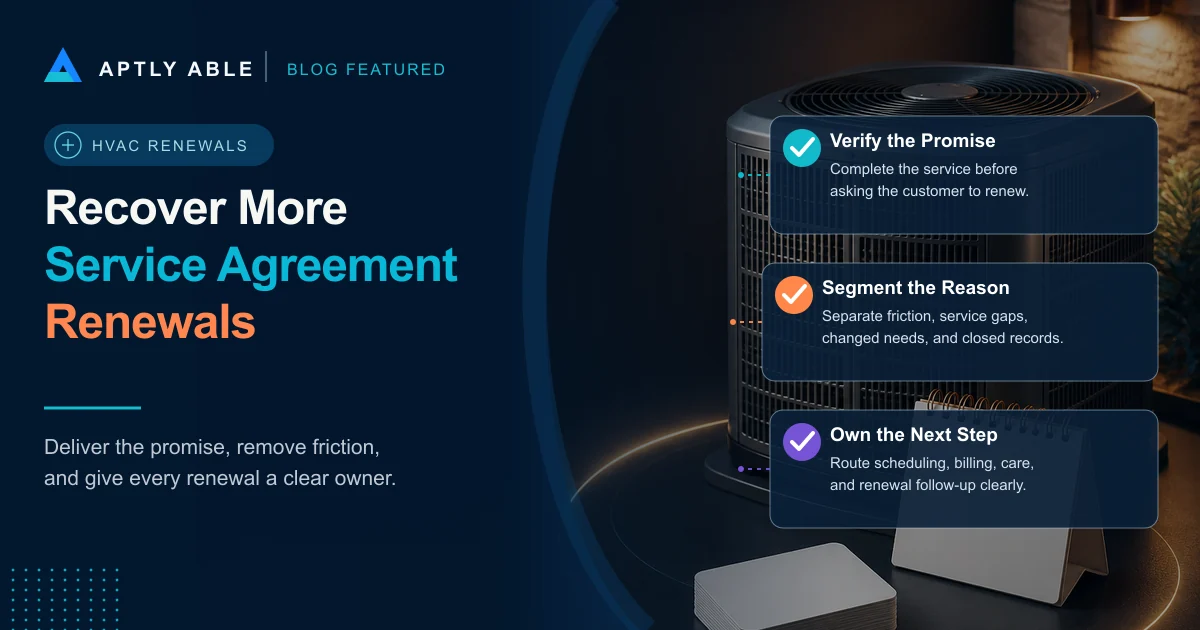
Before asking why a customer did not renew, ask whether the company delivered what the agreement promised.
Review the visits included in the plan, priority scheduling, discounts, waived fees, repair benefits, reminders, and any other stated value. ACCA's contractor guidance emphasizes that customers need to understand the benefits and that contractors should sell agreements only when they are in the customer's interest.[1] That same standard should govern renewal.
A customer who received every promised visit and used the benefits is a normal renewal opportunity. A customer who missed a tune-up because the company never scheduled it is a service-recovery case. A customer with an unresolved complaint should go to customer care before receiving another sales message.
Build those distinctions into the renewal list. Do not make the customer explain a broken promise to the third person who contacts them.
Build a Renewal Queue Before Agreements Expire
A renewal process should begin before the expiration date, not after the member disappears from active status.
Create a rolling queue with practical stages:
- Renewal approaching and all promised service complete.
- Renewal approaching with a visit still due.
- Payment method needs attention.
- Customer asked for a later decision.
- Agreement expired recently and is eligible for win-back.
- Agreement expired with an unresolved service issue.
- Customer declined, canceled, moved, replaced the system, or asked not to be contacted.
The purpose of the queue is not to create more reminders. It is to make the next action obvious. If a visit is still due, schedule it. If the payment method failed, make the update easy. If the customer wants to compare tiers, send a simple explanation. If the customer has already declined, record the reason and stop repeating the same request.
Each record should show the plan, expiration date, service history, equipment context, payment status, last meaningful conversation, assigned owner, due date, and final disposition.
Segment Renewal Opportunities by What Changed
A lapsed maintenance member is not one audience.
Some customers intended to continue but encountered friction. Their card expired, the invoice went to an old email address, or the renewal required a phone call during business hours. Others no longer see the value because they did not use the benefits or do not remember what was included. Some had a poor experience. Others moved, replaced the equipment, changed providers, or simply chose not to continue.
Use a small set of renewal segments:
- Friction: payment failure, outdated contact information, incomplete enrollment, or a missed administrative step.
- Value unclear: the plan was delivered, but the customer does not remember or understand the benefit.
- Service incomplete: a promised visit, discount, or follow-up was missed.
- Needs changed: equipment, property, budget, or service needs are different.
- Decision delayed: the customer asked to revisit the plan later.
- Closed: the customer declined or should not receive further renewal outreach.
The segment determines the conversation. Friction needs an easy fix. Unclear value needs a concise recap tied to actual service history. Service failure needs ownership and repair. Changed needs may require a different tier—or an honest acknowledgment that the plan no longer fits.
Make the Renewal Message Specific
“Your plan is expiring” is accurate, but it does not give the customer much reason to act.
A useful renewal message answers four questions:
- What plan does the customer have?
- What value did the customer receive?
- What is due next?
- What is the simplest next step?
For example: “Your maintenance plan is due to renew next month. We completed your spring visit, and your fall visit will be due in October. Would you like to keep the same plan, review the options, or have us close it?”
That message restores context and gives the customer control. It is better than a vague promotion because it reflects the relationship the business already has.
ACCA reports contractors using monthly payment structures to reduce manual annual-renewal work; one contractor interviewed said monthly-pay renewal rates reached the 90% range, while the same article also notes that some long-time customers still preferred annual invoices.[2] The operating lesson is not that every customer must use one billing model. It is that renewal should be easy while customer preferences remain visible.
Use Multiple Owners, but One Process
Renewal touches the office, field team, billing system, and customer database. That does not mean ownership should be vague.
The CSR can confirm contact details and schedule the next visit. The technician can reinforce the value during service. Billing can identify payment failures. A renewal specialist or outreach team can work the approaching-expiration and recent-lapse queues. Customer care can resolve service problems.
All of those actions should close into one shared process. Every attempt should record the outcome. Every promise should create a task. Every escalation should have an owner. A customer should not receive a renewal call from one department while another department is still handling a complaint.
Simpro's current guidance makes the same operational point: selling the agreement is only half the job, and missed promised visits or late renewal follow-up can undermine the renewal.[3] Renewal performance depends on delivery and follow-through, not just persuasion.
Recover Recently Lapsed Agreements With Context
A recent lapse deserves a different workflow from an agreement that ended years ago.
Start with customers whose plans expired recently, whose contact information is usable, whose service history is complete, and whose account has no unresolved issue or suppression. Restore the reason for the relationship before asking for the renewal.
A practical opening is: “You previously had our maintenance plan, and I’m checking whether you intended to let it end or whether something got in the way. Would you like to review the same plan, look at a different option, or leave it closed?”
That question helps the team learn. A failed card is different from a missed visit. A price concern is different from a move. A customer who no longer owns the home is not a win-back opportunity.
VoiceDrop can support this execution layer by working a defined list through real-person outreach, recording the response, and moving interested customers to the correct next step. The list still needs service history, suppression rules, renewal status, and clear routing before outreach begins.
Measure Renewal as a Journey, Not One Percentage
The final renewal rate matters, but it does not explain what needs fixing.
Track the full path:
- Agreements approaching expiration.
- Agreements with all promised service complete.
- Agreements with incomplete service.
- Valid renewal contacts.
- Successful conversations.
- Payment failures recovered.
- Same-plan renewals.
- Tier changes.
- Recent-lapse win-backs.
- Declines and decline reasons.
- Service-recovery escalations.
- Records closed because of move, replacement, bad data, or customer choice.
Break results down by plan type, payment method, location, technician, enrollment source, and whether promised service was completed. The goal is not to create a leaderboard from small samples. It is to identify where the renewal journey breaks.
If payment failures drive lapses, fix billing alerts. If customers do not remember the value, improve service summaries. If visits remain incomplete, repair scheduling capacity. If one plan tier consistently causes confusion, simplify the offer. If customers are interested but nobody follows up, tighten ownership.
A Practical 30-Day Renewal Reset
In week one, define the renewal stages and outcome codes. Pull agreements expiring in the next 60 to 90 days plus a recent-lapse group. Remove duplicates, suppress closed records, and separate incomplete-service cases.
In week two, verify what each plan promises and whether the business delivered it. Create routes for scheduling, billing, customer care, and renewal outreach. Write one short message for each major segment.
In week three, work a small pilot. Listen to the reasons customers give. Track conversations, renewals, payment fixes, service escalations, declines, and bad data. Do not expand until the handoffs work.
In week four, compare outcomes by segment and failure reason. Fix the biggest operational break, revise the messages, and set the queue to run continuously.
The strongest renewal system does not pressure every customer to stay. It makes the value visible, repairs broken promises, removes unnecessary friction, respects the customer's decision, and ensures every recoverable agreement has an owner.
HVAC Service Agreement Renewal FAQs
What is an HVAC service agreement renewal process?
An HVAC service agreement renewal process identifies plans approaching expiration, verifies that promised service was delivered, segments each account by renewal status, assigns the next action, records the outcome, and follows up on recoverable lapses.
When should an HVAC company start renewal outreach?
Start before expiration—often 60 to 90 days ahead for annual plans—so there is time to complete due service, correct account information, resolve payment problems, explain options, and schedule the next visit.
Why do HVAC maintenance agreements fail to renew?
Common reasons include expired payment methods, outdated contact details, unclear value, incomplete promised service, unresolved complaints, changed equipment or property needs, price concerns, and a renewal process with no clear owner.
Should HVAC maintenance plans renew automatically?
Automatic renewal can reduce administrative friction when terms, notices, payment authorization, and cancellation options are clear and compliant. Businesses should also preserve practical alternatives for customers who prefer annual billing or manual renewal.
How should an HVAC company win back lapsed maintenance members?
Begin with recently lapsed members who have usable contact data, completed service, no unresolved issue, and no suppression. Restore the customer's plan and service context, ask what caused the lapse, and offer the appropriate next step instead of using one generic sales pitch.
Which metrics improve HVAC service agreement renewals?
Track service completion, valid-contact rate, successful renewal conversations, payment failures recovered, renewal rate, tier changes, lapse reasons, win-backs, customer-care escalations, and the time from first renewal action to final outcome.
Recommended next reads
Related Aptly Able resources
- HVAC Revenue Recovery See how Aptly Able helps HVAC companies recover revenue from customer databases, calls, estimates, and field execution.
- Database Reactivation Turn underused customer records into organized, actionable revenue-recovery opportunities.
- VoiceDrop Use real-person outreach to work defined customer lists, capture interest, and route the next action.
- Customer List Segmentation for Reactivation Learn how to separate customer relationships, suppress unsuitable records, and prepare a list before outreach.
- Revenue Recovery Audit Identify whether the database, phones, old estimates, or field execution hold the clearest recovery opportunity.
Helpful external reading
- [1] ACCA: Strategies for Increasing Service Agreement Sales ACCA contractor guidance on agreement value, customer fit, renewal timing, and service-agreement execution.
- [2] ACCA: Charging Ahead With Service Agreements ACCA reporting on monthly payment options, automatic renewal, customer preferences, and agreement delivery.
- [3] Simpro: How to Sell HVAC Maintenance Agreements Current field-service guidance on delivering agreement promises, renewal follow-up, billing, and plan management.