
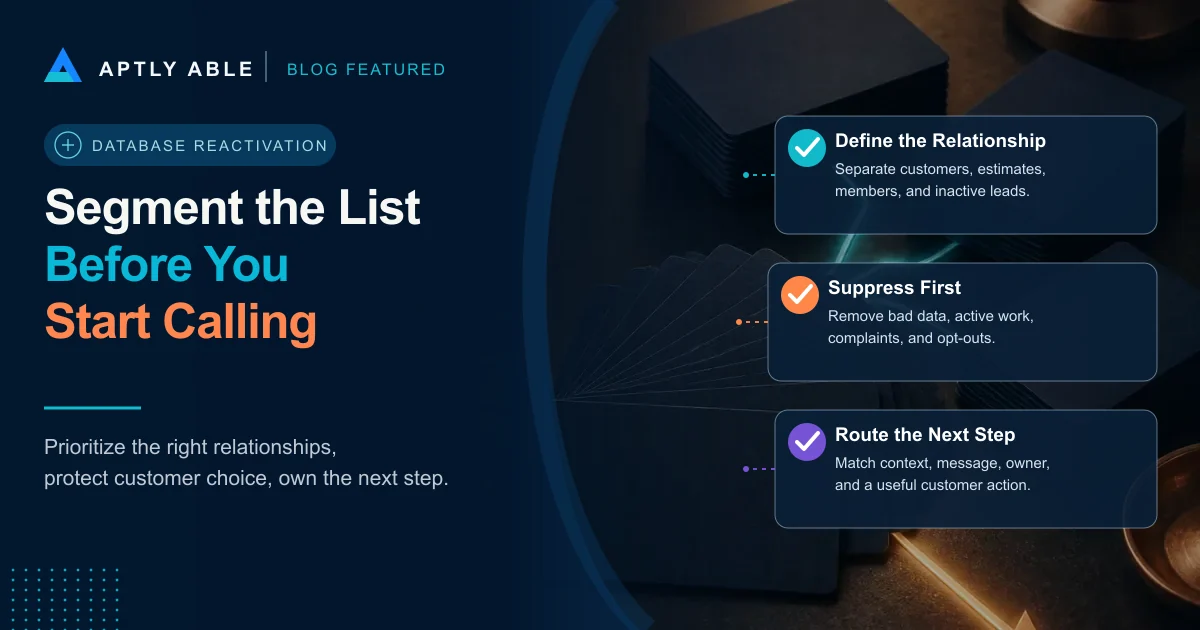
Customer Reactivation Starts With List Design
A customer database can look like one big opportunity. It is not.
Inside the same export, you may have loyal customers who are simply due for service, people who requested estimates but never bought, former customers who moved away, duplicate records, open complaints, recent buyers, disconnected numbers, and people who have already asked not to be contacted.
Treating all of them the same is how a reactivation campaign burns time, frustrates customers, and teaches the team that the database is not worth working.
The better approach is to segment the list before outreach starts. Segmentation is not about building a complicated model. It is about answering a practical question: who should receive which message, from whom, for what reason, and with what next step?
Most reactivation campaigns begin with the message. Someone writes a script, creates an offer, and then asks the CRM for every customer who has not purchased recently.
- A clear reason the customer belongs in it.
- A relevant reason to contact the customer now.
- A next action the outreach person can offer.
- An outcome that can be recorded consistently.
That order is backward.
Start by deciding what the campaign is supposed to recover. A maintenance visit, an unsold replacement estimate, a seasonal inspection, an accessory opportunity, and a lapsed membership are different conversations. They may all live in the same database, but they do not have the same context or buying cycle.
Write one campaign objective in plain language. For example: reconnect with residential customers whose equipment is likely due for maintenance and who have no future appointment scheduled. That definition gives the team something it can actually build and measure.
A good segment has four things:
If those four things are not clear, the list is not ready.
Define Inactive for the Service You Are Recovering
“Inactive” should not mean the same thing across every service line.
A customer who bought a system last month is active even if the CRM has not recorded another sale. A customer who needs annual maintenance may become a reactivation candidate after one missed service interval. A customer with an unsold estimate may deserve follow-up in days or weeks, not years. A past repair customer may be relevant when equipment age, season, or a known recurring need creates a useful reason to reconnect.
Build the inactivity rule around the normal customer journey:
- Last completed service date.
- Last purchase or invoice date.
- Membership status and renewal date.
- Estimate date and disposition.
- Equipment, product, or service category.
- Last meaningful inbound or outbound conversation.
- Open appointment, task, complaint, or warranty issue.
Do not let one field decide everything. A customer can look inactive in the sales table while an unresolved service issue is still open somewhere else. Pull enough context to understand the relationship before anyone calls.
Build the Suppression Layer Before the Priority Score
The first segment should be the people you should not contact through this campaign.
Remove or suppress duplicates, invalid contact information, deceased contacts, customers outside the service area, open legal or complaint matters, records with an active appointment, and anyone who has asked not to receive the relevant kind of outreach. Keep the suppression reason in the data so the same record does not quietly reappear in next month’s export.
Compliance also belongs in the list design, not as a disclaimer added after the campaign is built. The FTC explains that an established business relationship may allow certain live telemarketing calls to a number on the National Do Not Call Registry, but a customer’s company-specific do-not-call request still controls; prerecorded and automated outreach can involve different requirements.[1] The FTC also says CAN-SPAM applies to commercial email, including a message to former customers announcing a new product line, and requires businesses to honor email opt-out requests within 10 business days.[2] The FCC’s notice sets April 11, 2025 as the effective date for federal rules concerning revocation of consent for unwanted robocalls and robotexts.[3]
That is not a complete compliance analysis. State rules, communication method, consent language, message type, and the facts of the customer relationship can change what is allowed. Have qualified counsel review the campaign rules, and make suppression data available to every employee or vendor who performs outreach.
The operating principle is simple: a reactivation list is not permission to ignore customer choice.
Segment by Relationship Before You Segment by Value
A past customer is not the same as an old lead.
Start with the relationship because it changes the conversation. Useful top-level groups may include:
- Past customers with completed purchases or services.
- Current customers due for a recurring service or renewal.
- Unsold estimates with documented scope and timing.
- Inactive leads that previously expressed a specific need.
- Former members or subscribers who did not renew.
- Customers with an incomplete follow-up task or promised callback.
Only after those groups are separated should you rank value or likelihood. Otherwise, a large old estimate can rise to the top even though the customer already declined, chose a competitor, or asked not to be called. A smaller maintenance opportunity may be more timely, more useful to the customer, and easier for the team to serve well.
Relationship tells you how to open the conversation. Context tells you whether the conversation belongs on the list at all.
Add Recency, Relevance, and Readiness
A practical priority model does not need artificial precision. Use three questions.
First, how recent is the meaningful activity? Recent intent usually deserves a different workflow than a record that has been quiet for years. Recency should be measured from the event that matters to the campaign, not simply the last time anyone edited the contact.
Second, how relevant is the reason for outreach? Match the customer’s history to a current need the business can reasonably infer from its own records. An unsold estimate has a known scope. A maintenance customer has a service history. A former member has a known program. Relevance is stronger when the team can explain why it is calling without sounding like it bought a cold list.
Third, how ready is the business to serve the customer? Do not activate a segment if the schedule, inventory, territory, staffing, or handoff process cannot support the response. Generating interest without a clean next step creates another leak.
Use a simple high, medium, or low rating for each question. Keep the rules visible. If employees cannot explain why one record is ahead of another, the score is too complicated.
Use Value as a Routing Input, Not the Whole Strategy
Potential value matters, but it should not become the only priority.
A high-value estimate may deserve a senior rep with enough context to discuss the original recommendation. A recurring maintenance segment may need a fast scheduling workflow. A customer with a service concern may need customer care rather than sales. A broad win-back list may need a small pilot before more people are assigned.
Value should help determine the right owner, preparation, and level of effort. It should not turn every contact into the same sales pitch.
A useful routing table can be simple:
- Known unsold estimate: route to an advisor who can review scope and changes.
- Due or overdue recurring service: route to scheduling with available dates.
- Former member: route with renewal context and current program details.
- Prior customer with no obvious current need: use a permission-based check-in, not an urgent close.
- Unresolved issue: route to service recovery before any promotional conversation.
The best next action is the one that fits the customer’s actual history.
Match One Segment to One Message and One Next Step
Do not build one script for the entire database.
Each segment should have a short message brief that answers:
- Who is this person to us?
- Why are we contacting them now?
- What do we already know that they should not have to repeat?
- What useful next step can we offer?
- What should the outreach person do if the customer is not interested?
For an unsold estimate, the opening can acknowledge the prior proposal and ask whether the need was resolved. For maintenance, it can reference the service history and offer current availability. For an inactive lead, it can confirm whether the original need still exists before pushing for an appointment.
This is where good segmentation makes outreach feel human. The employee is not pretending to know the customer. The employee actually has the relevant context.
Pilot the Segment Before You Work the Entire List
A small pilot exposes problems while they are still cheap to fix.
Choose one well-defined segment and work enough records to test the data, message, routing, and outcome codes. Listen to what customers say. Watch for wrong numbers, outdated service history, confusing offers, unresolved complaints, and handoffs that the schedule cannot support.
Do not judge the pilot only by appointments. Track contact accuracy, successful conversations, customer interest, appointment requests, booked appointments, do-not-contact requests, wrong-fit records, unresolved needs, and the reasons people decline.
Then revise the segment. A campaign should get smarter as outcomes come back. If many customers already completed the work elsewhere, the timing may be late. If people are interested but cannot find an appointment, the constraint is operational. If employees keep needing information that is not in the export, the data model is incomplete.
A pilot is not a smaller version of the final campaign. It is how you learn what the final campaign should be.
Close the Loop in the CRM
A reactivation campaign is wasted if the outcome disappears into a spreadsheet.
Every worked record needs a disposition and, when appropriate, an owner and due date. Keep the outcome choices specific enough to improve the next campaign:
- Contacted and booked.
- Contacted and follow-up scheduled.
- Interested but timing is later.
- Need already resolved.
- Not interested.
- Do not contact.
- Wrong number or invalid data.
- Outside service fit.
- No answer after the approved attempt sequence.
- Escalated service or customer-care issue.
Write the result back to the system the business will use next time. Update the contact record, create the next task, preserve the suppression, and record what changed.
Without that loop, the same messy list gets exported again. With it, the database becomes more useful after every campaign.
Where VoiceDrop Fits
VoiceDrop is built for the execution layer: working existing customer and lead lists through real-person outreach, capturing warm interest, and moving qualified opportunities to the right next step.
But outreach cannot repair a list that was never defined. The campaign still needs a clear segment, usable context, responsible suppression rules, a relevant message, and a destination for every outcome.
That is why list preparation is part of revenue recovery. The goal is not to call the most people. The goal is to find the right existing opportunities, contact them for a reason that makes sense, and make sure the response goes somewhere useful.
Before you buy more demand, make the customer database you already own easier to understand and easier to act on.
Customer List Segmentation FAQs
What is customer list segmentation for reactivation?
Customer list segmentation for reactivation is the process of dividing inactive customers and leads into groups based on relationship, service history, recency, relevance, readiness, and next action before outreach begins.
Which customers should a reactivation campaign contact first?
Start with customers who have a clear prior relationship, a timely and relevant need, accurate contact data, no suppression or unresolved service issue, and a next step the business is ready to fulfill.
Should old estimates and past customers be in the same campaign?
Usually not. An old estimate has documented buying intent and scope, while a past customer may be due for a different service. Separate segments allow the team to use the right context, owner, message, and next action.
How many customer segments should a campaign use?
Use the fewest segments needed to create meaningfully different outreach. If two groups receive the same message, route, and next step, they may not need to be separate. Begin with one well-defined segment and expand after the pilot.
What should be removed from a customer reactivation list?
Suppress duplicates, invalid records, active appointments, open complaints or legal matters, out-of-area contacts, people who asked not to receive the relevant outreach, and records that do not fit the campaign’s service or timing rules.
How should a business measure a reactivation campaign?
Measure data accuracy, contact rate, meaningful conversations, customer interest, appointments requested and booked, follow-up completion, suppression requests, wrong-fit records, unresolved issues, and final revenue outcomes where available.
Recommended next reads
Related Aptly Able resources
- Database Reactivation See how Aptly Able helps businesses turn underused customer records into organized, actionable revenue-recovery opportunities.
- VoiceDrop Use real-person outreach to work existing customer and lead lists, capture warm interest, and create clear next steps.
- Findlay Toyota Cold-Lead Reactivation Case Study See a documented example of structured database outreach turning an existing list into measurable sales opportunities.
- What Is Revenue Recovery? Learn how customer databases, calls, and field appointments fit into a complete revenue-recovery system.
- Revenue Recovery Audit Identify whether the customer database, phones, old estimates, or field execution hold the clearest recovery opportunity.
Helpful external reading
- [1] FTC: Complying with the Telemarketing Sales Rule FTC guidance on telemarketing requirements, Do Not Call provisions, established business relationships, and company-specific do-not-call requests.
- [2] FTC: CAN-SPAM Act compliance guide FTC guidance for commercial email, including former-customer messages, unsubscribe requirements, and opt-out processing.
- [3] FCC: Rules on revoking consent for unwanted robocalls and robotexts FCC public notice establishing the effective date for federal consent-revocation rules affecting unwanted robocalls and robotexts.