
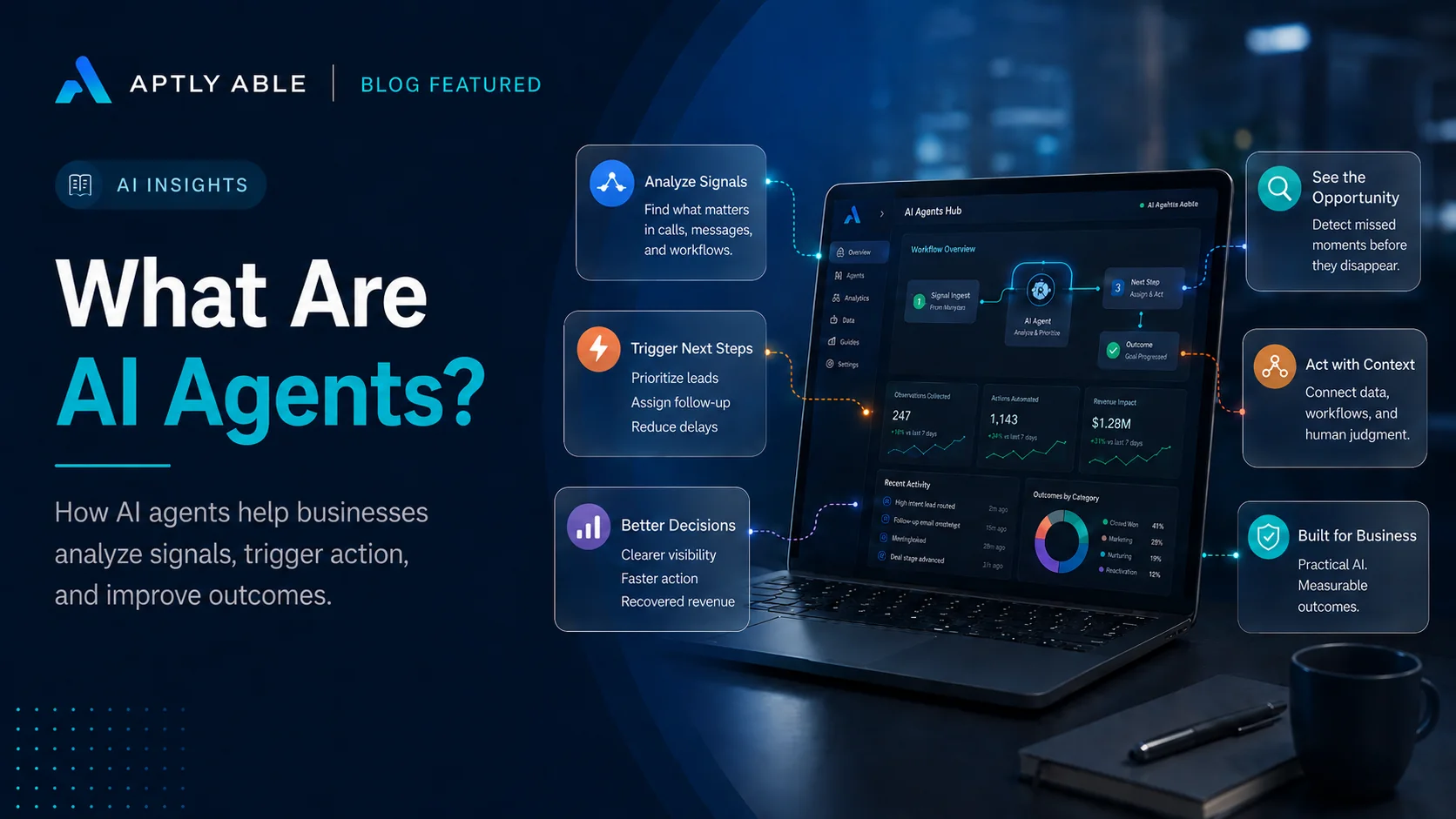
What Are AI Agents?
A lot of companies are hearing about AI agents right now. They are being described as digital employees, autonomous workers, virtual teams, and the next major change in business technology. Some of that is real, some of it is marketing, and a lot of it sounds more complicated than it needs to be.
The simplest way to think about an AI agent is as a system that can review information, understand what is happening, determine what needs to happen next, and help take action. That is different from a basic chatbot, which usually waits for someone to ask a question, provides an answer, and ends the interaction.
An AI agent can potentially follow an entire process. It might review a customer conversation, recognize that the customer asked for pricing, notice that no appointment was booked, identify that follow-up was promised, and check whether that follow-up actually happened. It can then alert the right person or help initiate the next step.
That is where AI agents become useful for a business. The value is not simply that the AI can talk. The value is that it can help work move forward.
What Does an AI Agent Actually Do?
The word “agent” makes the technology sound more mysterious than it is. In practical terms, an AI agent usually combines several capabilities: it receives information, analyzes what happened, compares the situation against a goal or business process, identifies what needs attention, and then recommends or completes an action.
Imagine a customer calls an HVAC company because their air conditioner has stopped working. The call is answered, but the customer does not schedule an appointment.
A basic transcription tool can turn the call into text. A summarization tool might report that the customer called about an air-conditioning problem and asked about availability. That is useful, but it still leaves the manager with a considerable amount of work. Someone has to read the summary, recognize that the customer was a legitimate opportunity, notice that the appointment was not booked, decide whether the customer should be called back, and then make sure that call actually happens.
An AI agent can help connect those steps. It can recognize that the call contained buying intent, determine that the desired outcome did not occur, flag the opportunity while it is still fresh, and route it to the appropriate person for recovery. Depending on how the system is designed, it may also help draft the follow-up, update the customer record, create a task, or verify later that the task was completed.
That is more than analysis. It is analysis connected to action.
AI Agents Are Really Workflow Systems
This is where a lot of companies get distracted. They focus on how intelligent the AI appears and ask whether it can speak naturally, write emails, answer questions, or carry on a conversation. Those capabilities matter, but the larger question is whether the AI understands the business workflow.
What is supposed to happen when a new lead calls? What qualifies as a real opportunity? When should an appointment be offered? What information needs to be collected? Who owns the next step? How quickly should follow-up happen? What should occur if the customer does not respond, and when should a manager become involved?
An AI agent cannot improve a workflow that the business itself does not understand. If the process is unclear, the AI may simply automate the confusion.
That is why successful AI implementation usually starts with the business problem, not the technology. Instead of asking, “Where can we install an AI agent?” a company should ask, “Where is important work repeatedly getting delayed, missed, or handled inconsistently?”
That is where an agent may provide real value.
Where Can Businesses Use AI Agents?
AI agents can support many parts of a business, but the most useful applications usually involve repeated workflows with clear outcomes.
Customer Service
An AI agent can help categorize customer issues, locate relevant information, recommend a response, route the issue to the correct department, and identify situations that require escalation. This can reduce the time employees spend searching through systems or trying to determine what happened during previous interactions. It can also help customers receive faster and more consistent answers.
The goal, however, should not be to keep every customer away from a human being. The goal should be to resolve simple issues efficiently while making sure important or complicated situations reach the right person quickly.
Sales Follow-Up
A business may generate plenty of leads and still lose revenue because follow-up is slow or inconsistent. An AI agent can identify interested prospects, prioritize the strongest opportunities, create follow-up tasks, draft messages, and alert salespeople when a prospect needs immediate attention.
It can also identify promises made during calls or meetings and determine whether those promises were fulfilled. That matters because many opportunities are not lost through a dramatic failure. They are lost because nobody took the next step.
Call Analysis and Revenue Recovery
Phone calls contain valuable information about customer intent, objections, buying questions, service problems, and missed appointments. An AI agent can review those conversations and identify which ones require action.
The system might find a customer who was ready to buy but was never asked to schedule. It might identify a caller who requested a quote but never received one, notice that a customer was told someone would call back but no follow-up occurred, or identify the same objection appearing repeatedly across dozens of calls.
The important part is not merely finding those moments. It is making sure the company can do something about them.
Field Sales and Service
A great deal of important customer information is created outside the office. It happens during home estimates, dealership visits, inspections, service appointments, and face-to-face sales conversations.
An AI agent can help organize information captured in the field, identify commitments, summarize customer needs, and surface coaching or follow-up opportunities. It can help answer questions such as: What did the customer care about most? Which option did the representative recommend? What objection prevented the sale? Was a follow-up date established? Did the representative make a promise that now needs to be completed?
This gives managers visibility into an important part of the customer journey that is often difficult to measure.
Internal Operations
AI agents can also assist with repeated internal processes. They may review incoming forms, verify that required information is present, create tasks, route approvals, update systems, or notify employees when something is overdue.
This type of work does not always look exciting, but correcting small operational failures can create meaningful business value. A missing field on an onboarding form can delay a customer launch. An unassigned support request can sit unanswered. A sales commitment can disappear between a meeting and the CRM. A manager can spend hours every week collecting updates that already exist across several disconnected systems.
AI agents can help connect that information and keep the process moving.
What AI Agents Should Not Do
There is a tendency to treat every new AI capability as a reason to remove people from the process. That is usually the wrong starting point.
AI agents should not automatically make important decisions without appropriate oversight. They should not be given unlimited access to customer information, financial systems, or business tools. They should not communicate with customers without clear rules, approved information, and a reliable way to escalate situations when they are uncertain. They also should not be expected to understand every exception on the first day.
Most importantly, AI agents should not replace human judgment in situations where context, empathy, responsibility, or experience matters. The best systems know where their responsibility ends.
An AI agent may identify a frustrated customer and alert a manager, but it should not always be trusted to decide how that relationship should be repaired. It may recognize that an opportunity was missed, but a salesperson may still need to determine the best way to reopen the conversation. It may find that an employee is struggling with a particular part of the sales process, but a manager should still provide the coaching.
AI should make people better. It should help them see more clearly, respond more quickly, and operate more consistently. It should not remove people simply because the technology can complete part of the task.
AI Agents Need Good Data and Clear Context
An AI agent is only as useful as the information and instructions it receives. A generic system may understand that a customer asked about price. A company-aware system should understand which product the customer discussed, whether the price was quoted correctly, which next step should have been offered, and who owns the follow-up.
That requires context. The agent may need access to approved product information, service areas, operating hours, pricing rules, scheduling requirements, escalation procedures, customer records, and company policies.
It also needs clear boundaries. Which actions can it complete automatically? Which actions require employee approval? Which situations must be escalated? What information is it permitted to access? How will the company verify that its conclusions are accurate?
These are not minor technical details. They determine whether the agent becomes a useful operating system or simply another source of noise.
AI Agents Will Not Fix a Broken Process by Themselves
A lot of business problems get blamed on a lack of technology when the real problem is that nobody owns the process.
The lead came in, but no one had clear responsibility for responding. The call was answered, but the representative was never trained to ask for the appointment. The follow-up task was created, but managers did not have a system for checking whether it happened. The customer information was collected, but it was spread across several disconnected tools.
Adding an AI agent does not automatically solve those problems. The business still needs a clear definition of success. It still needs ownership, standards, and employees who understand what the system is intended to accomplish.
AI can make a strong process faster and more consistent. It can also reveal where a weak process is breaking. What it cannot do is replace leadership.
How Should a Business Start Using AI Agents?
The best place to start is usually not a massive company-wide deployment. It is one expensive, repeated problem.
Look for a process where opportunities are being missed, employees are spending too much time reviewing information, or customers are waiting because the next step is unclear. Then define the desired outcome.
For example, perhaps every qualified inbound lead should receive a response within five minutes. Maybe every customer who requests an appointment should either be scheduled or placed into a recovery process. Every promised follow-up could be tracked until completion, every field estimate could produce a clear summary and assigned next step, or every urgent customer complaint could be escalated to a manager.
Once the desired outcome is clear, the company can determine where an AI agent might help. Can it identify the correct event? Can it determine whether the required action occurred? Can it notify the right person? Can it complete part of the process safely? Can the business measure whether the result improved?
That last question matters. An AI agent should not be judged by how impressive the demonstration looks. It should be judged by whether more appointments were booked, customers received faster answers, employees saved time, problems were resolved, and fewer opportunities disappeared.
The Real Value of AI Agents
AI agents are not valuable because they are new. They are valuable when they help businesses act on information that would otherwise be ignored.
Most companies already have more information than their teams can realistically review. They have phone calls, emails, CRM notes, service records, meeting recordings, website inquiries, customer messages, and field conversations. The problem is not always collecting more data. The problem is understanding what matters inside that data and making sure someone acts on it.
That is the opportunity AI agents create. They can help businesses find the lead that needs a response, the customer who needs help, the promise that has not been fulfilled, the appointment that should have been booked, the employee who needs coaching, the process that keeps breaking, and the revenue opportunity that is still recoverable.
At Aptly Able, that is how we think about practical AI. The goal is not to add AI simply because companies are being told they need it. The goal is to create systems that see what people cannot review at scale, identify what matters, and help the team take the right next step.
Because the best AI agent is not the one that looks the most human. It is the one that helps the business operate better.
Frequently Asked Questions About AI Agents
What is an AI agent?
An AI agent is a software system that can analyze information, determine what needs to happen next, and help perform or coordinate an action. Unlike a basic chatbot, an AI agent can participate in a multi-step business workflow.
How are AI agents different from chatbots?
A chatbot generally responds to a user’s question or request. An AI agent can review information, apply business rules, use connected tools, track a process, and initiate the next step with appropriate oversight.
What are examples of AI agents in business?
Business AI agents can prioritize sales leads, review customer calls, route support requests, create follow-up tasks, update CRM records, summarize field appointments, monitor commitments, and escalate urgent issues.
Can AI agents replace employees?
AI agents can automate parts of repetitive workflows, but they are most valuable when they support employees. Human judgment remains important for complex decisions, sensitive customer interactions, coaching, exceptions, and accountability.
Are AI agents safe for customer service?
They can be when they have clear permissions, approved information, defined escalation rules, human oversight, and ongoing performance evaluation. Businesses should not give an AI agent unrestricted authority or access.
What is agentic AI?
Agentic AI refers to artificial intelligence that can work toward a goal through multiple steps instead of producing only a single answer. It may analyze information, select an action, use connected tools, and evaluate what should happen next.
How can a small business use AI agents?
A small business can begin with one repeated problem, such as slow lead response, missed follow-up, unreviewed calls, support routing, or incomplete customer onboarding. The system should be tied to a clear outcome that the business can measure.
How do you measure the ROI of an AI agent?
ROI can be measured through outcomes such as faster response times, more appointments booked, higher lead conversion, fewer missed follow-ups, reduced administrative work, improved customer satisfaction, and recovered revenue.
Recommended next reads
Related Aptly Able resources
- CallSense See how Aptly Able uses AI to analyze customer calls, surface missed opportunities, and support revenue recovery.
- FieldSense Learn how conversation intelligence turns field appointments into actionable summaries, follow-up, and coaching.
- Revenue Recovery Audit Find the missed calls, follow-up gaps, and workflow breakdowns already costing your business revenue.
- AI Should Make People Better, Not Replace Them Explore Aptly Able’s practical approach to using AI to strengthen human performance and judgment.