
What Bid Recovery Means
Bid recovery is the process of following up on estimates that were delivered but never approved, then giving qualified customers a clear reason and an easy path to continue the conversation.
In home services, people also call this unsold estimate follow-up or rehash. The name matters less than the operating discipline. The estimate cannot disappear into the CRM after the technician or comfort advisor leaves.
ServiceTitan describes a follow-up coordinator as the person responsible for additional touches on unsold estimates that are at least 48 hours old.[1] That definition points to the real issue: bid recovery needs an owner. If responsibility belongs to everybody, it usually belongs to nobody.
This is not the same as chasing every quote forever. Good bid recovery separates real opportunities from closed decisions, learns why a customer paused, and helps the business take the correct next action.
An Unsold Estimate Is Not Automatically a Lost Job
Customers pause for all kinds of ordinary reasons. They need to talk with a spouse. They are comparing options. They are waiting on financing, a rebate, a schedule, or another repair. They got busy. They did not understand part of the proposal. Sometimes they intended to call back and simply did not.
None of those situations guarantees a sale. But none of them proves the opportunity is dead either.
ServiceTitan published an example in which a customer wanted a proposed garage-door upgrade, received approval from his spouse, got busy, and never heard from the contractor again.[2] The lesson is simple: a silent customer and an uninterested customer are not always the same person.
The purpose of follow-up is not to pressure the customer. It is to find out what changed, answer the question that is holding up the decision, and make the next step easier.
Why Contractors Miss Bid-Recovery Opportunities
Most teams do not ignore open estimates on purpose. The work gets crowded out by today's calls, today's appointments, today's breakdowns, and today's revenue.
The salesperson plans to follow up, but another lead arrives. The office sees an open estimate but assumes the field rep owns it. The manager sees a weak close rate but cannot tell whether the issue was price, presentation, financing, timing, or missing follow-through.
ServiceTitan's contractor playbook recommends one accountable follow-up owner, access to the estimate history, flexible call guidelines, role-play, cross-functional training, and clear goals.[1] Those are not software features. They are operating choices.
Technology can organize the queue and surface the right context. It cannot fix unclear ownership by itself.
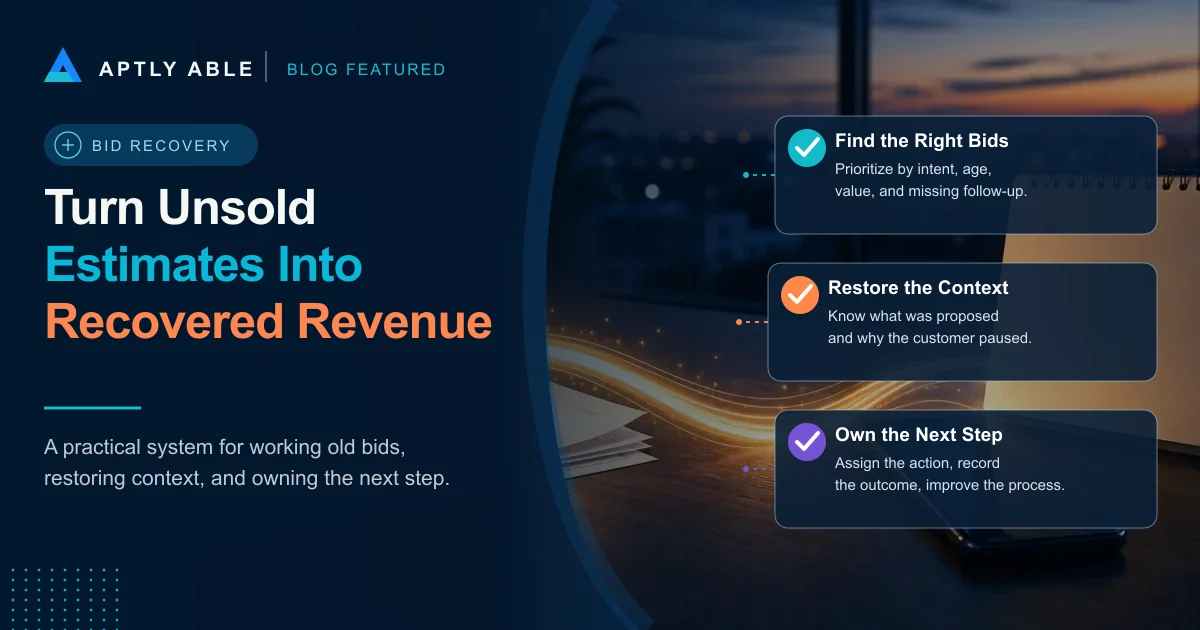
How to Build a Bid-Recovery Process
A useful process is simple enough to run every day and specific enough to measure.
- Build and clean the eligible estimate queue.
- Review customer, proposal, and field-conversation context.
- Assign one owner and one next action.
- Use a relevant message instead of a generic check-in.
- Record the outcome and the reason.
- Feed repeated objections and breakdowns back into coaching.
Start with a clean queue. Include open estimates that meet your timing rules, exclude jobs that were explicitly declined or awarded elsewhere, remove duplicates, and suppress anyone who should not be contacted.
Next, give every estimate context. Review the customer's history, the proposed work, options presented, financing discussion, timing, objections, and promises made in the home. ServiceTitan's estimate-follow-up guidance tells teams to review the full customer history before making contact.[2] A generic ‘just checking in’ message wastes that advantage.
Then assign one next action and one owner. The action may be a phone call, a personal email, a permitted text, a revised proposal, a financing conversation, or a handoff back to the field representative. The owner should know when the action is due and what outcome closes the task.
Finally, record the disposition. A useful result is not only won or lost. Track reasons such as timing, price, financing, scope confusion, competitor selection, no decision, no response, and do-not-contact. Those reasons improve future coaching and help the company see where its sales process is actually breaking.
What Good Unsold Estimate Follow-Up Sounds Like
A strong follow-up starts with service, not pressure.
The customer should understand who is calling, which estimate the conversation concerns, and why the call may be useful. The person following up should be ready to recap options, answer questions, reconnect the customer with the right employee, or close the loop respectfully.
A practical opening might sound like this: ‘I'm following up on the options our team prepared for your home. Before we close the estimate, I wanted to make sure your questions were answered and see whether timing, scope, or financing is holding anything up.’
That question gives the customer room to tell the truth. It also gives the business useful information. If the answer is no, record it and move on. If the answer reveals a solvable problem, solve the problem.
Bid Recovery Needs Field Context
The CRM can show that an estimate is open. It may not show why it is open.
The useful details often live inside the field conversation: what the customer cared about, which option felt right, what concern changed the tone, whether a spouse was absent, what the technician promised, and what the customer said they needed next.
This is where FieldSense fits. Better field visibility gives the follow-up team a better starting point and gives managers evidence for coaching. The goal is not to monitor people for the sake of monitoring them. The goal is to preserve the context that helps the customer and improves execution.
When the same objection appears across many estimates, that is a coaching signal. When follow-up repeatedly stalls because notes are incomplete, that is a process signal. When one option consistently creates confusion, that may be a proposal signal. Bid recovery should improve the front end of the sales process, not only work the back end.
Use Automation Carefully and Keep Consent Central
A follow-up system should make outreach more organized, not less responsible.
The FCC says prerecorded telemarketing calls require prior written consent and commercial texts require written consent; consumers may also revoke consent in a reasonable manner.[4] The FTC's Telemarketing Sales Rule adds requirements involving disclosures, calling times, do-not-call procedures, caller identification, and records, while state laws may add more.[5]
That means a business should not upload every old contact into an automated sequence and assume prior contact equals permission for every channel. Define eligibility with counsel, retain consent and opt-out records, honor company-specific do-not-call requests, and make suppression part of the workflow before a campaign launches.
Compliance is not a paragraph at the bottom of a script. It is part of list selection, channel selection, timing, message design, recordkeeping, and vendor oversight.
What to Measure
Do not judge bid recovery only by total dollars closed. That matters, but it does not tell you whether the process is getting healthier.
Track the percentage of eligible estimates that received an on-time first touch, contact rate, response rate, appointments or proposal reviews reopened, recovered jobs, recovered revenue, average days to resolution, opt-outs, and disposition reasons.
Also compare outcomes by department, representative, estimate type, age, and original objection. The point is not to create a leaderboard with no context. The point is to see where the process works, where it breaks, and what deserves coaching.
A small queue handled consistently is more valuable than a giant report nobody owns.
Where Bid Recovery Fits in Revenue Recovery
Bid recovery is one part of a larger revenue-recovery system.
VoiceDrop helps work existing lists, old bids, and inactive opportunities through live outreach. FieldSense helps preserve what happened during the in-home conversation and improve the follow-through that comes after it. CallSense helps surface phone opportunities and promised actions that might otherwise be missed.
The common idea is straightforward. Before buying more leads, make sure the business can see, work, and learn from the opportunities it already earned.
Start with the open-estimate report. Clean it. Assign it. Work it. Measure it. Then use what you learn to make the next estimate less likely to disappear.
Bid Recovery and Unsold Estimate Follow-Up FAQs
What is bid recovery?
Bid recovery is the process of following up on delivered but unapproved estimates, identifying why the customer paused, and helping qualified opportunities reach a clear next step.
Is bid recovery the same as rehash?
In home services, bid recovery, rehash, and unsold estimate follow-up often describe the same core work: systematically revisiting open quotes instead of letting them disappear in the CRM.
When should a contractor follow up on an unsold estimate?
The right timing depends on the work and the customer's stated next step. Many contractors begin within one or two business days, then use a defined cadence rather than leaving follow-up to memory.
Who should own unsold estimate follow-up?
One clearly accountable person or team should own the queue, next actions, and dispositions. Salespeople and field staff can participate, but the process needs a named owner.
What should a bid-recovery team track?
Track eligible estimates, on-time first touches, contact and response rates, reopened conversations, recovered jobs and revenue, days to resolution, opt-outs, and the reasons customers did not move forward.
Can contractors automate old-estimate follow-up?
Contractors can automate parts of the workflow, but channel-specific consent, do-not-call rules, opt-outs, state requirements, accurate suppression, and human review must be built into the process.
Recommended next reads
Related Aptly Able resources
- HVAC Revenue Recovery See how HVAC contractors recover old estimates alongside missed calls, customer lists, and field opportunities.
- VoiceDrop Turn old bids, past customers, and inactive leads into warmer conversations through live outreach.
- FieldSense Capture what happened in the field so estimate follow-up starts with better context and more useful coaching insight.
- Revenue Recovery Audit Find out whether old estimates, missed calls, customer lists, or field execution hold your clearest recovery opportunity.
- What Is Revenue Recovery? See how bid recovery fits into the larger process of recovering opportunities a business already earned.
Helpful external reading
- [1] ServiceTitan: Rehash and follow-up coordinator playbook ServiceTitan explains how contractors assign ownership of additional touches on unsold estimates and build a repeatable follow-up process.
- [2] ServiceTitan: Following up on estimates A field-service example of reviewing open estimates, researching customer history, and following up with useful context.
- [4] FCC: Robocall and robotext consent rules Current FCC consumer guidance on consent, opt-outs, prerecorded telemarketing, and commercial texts.
- [5] FTC: Complying with the Telemarketing Sales Rule FTC business guidance covering telemarketing disclosures, calling restrictions, do-not-call requirements, and recordkeeping.