
What Missed Call Recovery Means
Missed call recovery is the process of identifying inbound calls that did not become a completed customer conversation, deciding which ones still need action, and giving each recoverable opportunity a clear owner and next step.
That definition is intentionally broader than ‘call back every voicemail.’ A caller can disconnect before voicemail. A call can ring out, hit a busy line, fail in routing, reach the wrong department, or end without an appointment. The real question is not simply whether the phone rang. It is whether the customer got helped.
Modern phone systems can expose useful call records. Twilio’s Call resource, for example, can retrieve completed calls and classify outcomes including completed, busy, no-answer, failed, and canceled.[1] The specific labels vary by provider, but the operating opportunity is the same: build a reliable list of calls that may need recovery instead of leaving the work to memory.
A Missed Call Is a Revenue Event, Not Just a Phone Event
When a business pays to generate demand, an unanswered call is connected to more than the phone system. It may be connected to an ad click, a referral, a repeat customer, an old estimate, a service issue, or a high-intent buyer who is ready to schedule.
Google Ads call reporting illustrates the connection between marketing and phone outcomes. When enabled, it can report details such as call duration, start time, whether the call connected, and—subject to regional rules—a caller phone number for calls over 15 seconds.[2] Google also allows advertisers to count calls that meet a chosen duration as conversions.[2]
That data is useful, but duration alone does not tell you whether the business won the opportunity. A two-minute call can end without a booking. A short call can be a valuable existing customer who was transferred poorly. A no-answer record can be an urgent prospect who is still recoverable.
The phone report tells you where to look. The conversation and the follow-up tell you what happened.
What Counts as a Recoverable Missed Call?
Not every call belongs in a recovery queue. Spam, wrong numbers, duplicate attempts, abandoned calls that were answered on the next try, and callers who asked not to be contacted should be removed or suppressed.
A practical queue usually includes:
- Calls marked no-answer, busy, failed, or abandoned before a useful conversation.
- Voicemails that have not received a documented response.
- Calls that connected but ended without a promised callback, appointment, estimate, or handoff.
- After-hours calls that did not reach the right person.
- Repeat callers whose earlier attempts show unresolved intent.
- Calls from paid campaigns that generated activity but no recorded outcome.
This is why missed call recovery should not be built from one phone-status field alone. It works best when call records, recordings or transcripts, CRM activity, scheduling data, and follow-up tasks can be reviewed together.
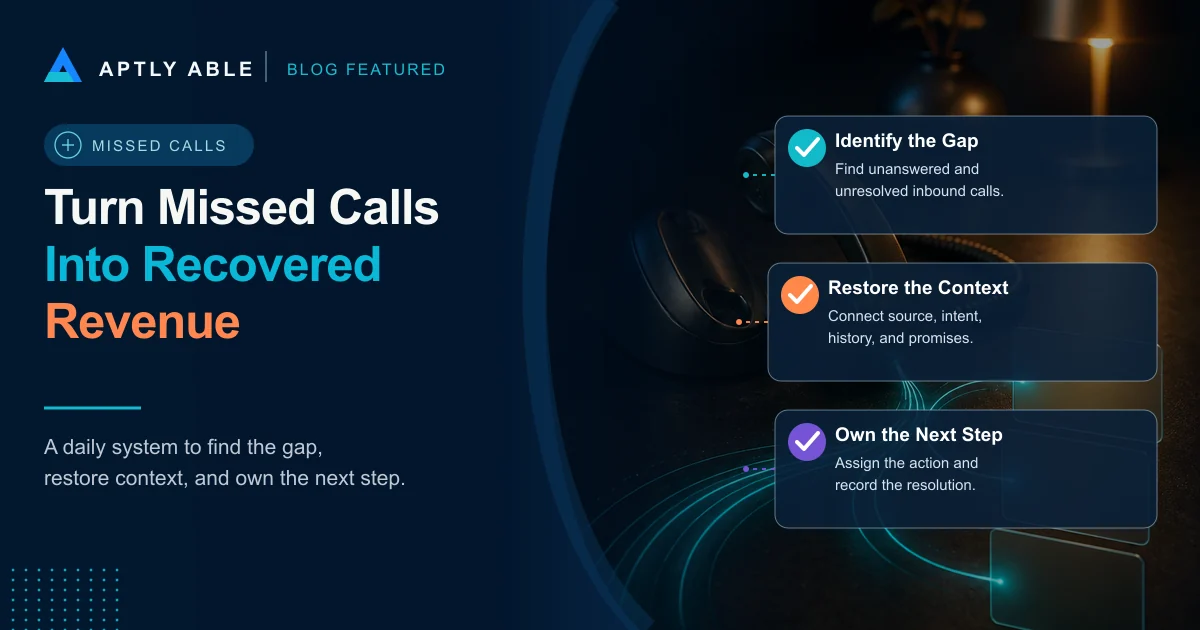
Build a Daily Missed Call Recovery Queue
The process should be simple enough to run every day.
Start with one source of truth. Pull the previous day’s unanswered and unresolved calls into one queue. If the business has multiple locations, departments, tracking numbers, or phone providers, normalize the records so the team is not working from separate reports.
Then remove noise. Suppress known spam, duplicates, existing open tasks, and calls that already reached a clear resolution. The goal is not to create the biggest possible list. It is to create a trustworthy list.
Next, add context. Show the caller’s prior history, source, department, time of call, voicemail, transcript or summary, recent estimate, and any promise made by the team. Context changes the callback from ‘We saw you called’ to ‘I’m following up on your request for an appointment this afternoon.’
Finally, assign one owner and one deadline. A queue without ownership becomes another report. Every recoverable call should show who will act, what action is due, and which outcome will close the task.
Recover the Customer, Not Just the Call
A good callback does not make the customer repeat the entire story.
The employee should know what the business already knows, acknowledge the missed connection, and move quickly toward service. A practical opening is: ‘I’m sorry we missed you. I’m following up on your call about scheduling service. Are you still looking for help?’
If the original call contained more context, use it. If the customer asked about a replacement estimate, route the callback to someone who can discuss the estimate. If the caller reported an urgent service problem, prioritize the operational need. If the call exposed a billing or customer-care issue, do not force it into a sales script.
Recovery is not about treating every caller like a lead. It is about making sure the business responds appropriately to the reason the person called.
Measure the Whole Path From Ring to Resolution
Answer rate matters, but it is not enough.
Track total inbound calls, live-answer rate, no-answer and busy outcomes, abandoned calls, after-hours volume, time to first recovery attempt, contact rate, recovered appointments, documented resolutions, repeat attempts, and unresolved calls aging in the queue.
For paid campaigns, compare the phone system with advertising and CRM outcomes. Google’s call reporting uses forwarding numbers to connect ad interactions with call details, and its reporting can help advertisers review calls generated from ads.[2] Google’s Business Calls API documentation also describes location-level insights such as missed calls and notes that eligible calls linked with Google Ads may appear as ‘Calls from Ads’ conversions.[3]
Do not assume those platform reports replace operational truth. Reconcile source, call status, booking, revenue, and final disposition. If advertising shows a conversion but the CRM shows no appointment, that gap deserves attention.
Use Missed Calls to Improve the Business
The recovery queue solves today’s problem. The pattern behind the queue helps solve tomorrow’s.
If calls are missed during lunch, change coverage. If one location has more failed transfers, inspect routing. If after-hours callers repeatedly need urgent scheduling, improve the handoff. If calls connect but do not book, review the conversation instead of blaming marketing. If callbacks happen but are too late to help, tighten ownership and alerts.
CallSense is useful here because the opportunity is not limited to unanswered calls. It can help surface what happened inside connected calls: buying intent, missed booking opportunities, promised follow-up, weak handoffs, and coaching needs.
The goal is not to create a surveillance system or a wall of dashboards. The goal is to help the team see the work that matters and act on it.
Where Missed Call Recovery Fits in Revenue Recovery
Missed call recovery is one layer of a larger revenue-recovery system.
CallSense helps identify missed phone opportunities and the conversations that need action. VoiceDrop helps work existing customer lists, old bids, and inactive leads through live outreach. FieldSense helps preserve what happened during in-person appointments so recommendations, commitments, and next steps do not disappear after the visit.
The common principle is simple: before spending more to create new demand, make sure the business can see and work the demand it already earned.
Start with yesterday’s unanswered calls. Remove the noise. Add the context. Assign the work. Record the outcome. Then use the pattern to improve staffing, routing, coaching, and follow-up.
A missed call should not be invisible. It should become a decision.
Missed Call Recovery FAQs
What is missed call recovery?
Missed call recovery is the process of identifying unanswered or unresolved inbound calls, prioritizing the calls that still represent a real customer need, and assigning a clear follow-up action and owner.
Which calls should go into a recovery queue?
Include no-answer, busy, failed, abandoned, after-hours, unresolved voicemail, and connected calls with missing promised follow-up. Remove spam, duplicates, resolved calls, and contacts who should not be called.
How quickly should a business recover a missed call?
As quickly as the business can respond with the right context and the right person. Urgent service requests and high-intent scheduling calls should be prioritized ahead of routine or unclear calls.
What should a missed call recovery team track?
Track live-answer rate, unanswered outcomes, time to first recovery attempt, contact rate, recovered appointments, documented resolutions, repeat attempts, and unresolved calls still aging in the queue.
Is a voicemail callback system enough?
No. Many recoverable calls do not produce a voicemail, and some connected calls still end without a booking, handoff, or promised follow-up. A complete process uses call status plus conversation and CRM context.
Can AI help recover missed calls?
AI can organize call records, summarize conversations, identify intent, flag missing follow-up, and prioritize work. People should still own customer judgment, sensitive situations, and the actual next action.
Recommended next reads
Related Aptly Able resources
- Missed Call Recovery See how Aptly Able helps service businesses identify, prioritize, and act on missed phone opportunities.
- CallSense Use AI call analysis to surface buying intent, broken follow-up, weak handoffs, and coaching opportunities.
- Revenue Recovery Audit Find whether missed calls, old estimates, customer lists, or field execution hold your clearest recovery opportunity.
- Why HVAC Companies Lose Leads They Already Paid For Learn how missed calls, unrecognized intent, and weak follow-up turn paid demand into lost HVAC revenue.
Helpful external reading
- [1] Twilio: Call resource documentation Twilio documents completed-call records and call outcomes such as completed, busy, no-answer, failed, and canceled.
- [2] Google Ads: About call reporting Google explains call reporting, forwarding numbers, connection details, call duration, and phone-call conversions.
- [3] Google Business Calls API Google documents location-level business-call insights, including missed calls and eligible Calls from Ads conversions.