Why In-Home Appointments Fail to Close
Home-service companies spend a significant amount of time, money, and energy getting to the in-home appointment. Marketing campaigns to generate the lead. CSRs to answer the call and get the booking. Dispatch to route the right tech at the right time. All of that effort, all of that overhead, just to get a person in front of a customer inside their home.
And then, more often than people realize, nothing happens.
The appointment runs. The tech does good work. The customer seems satisfied. A quote gets sent. And then the silence sets in. No callback from the customer. No follow-up from the company. The job that should have been booked just quietly disappears.
For most service businesses, this is one of the most expensive problems they have. And because it does not show up as a single visible failure, it tends to go unaddressed for a long time.
The Math That Makes This Urgent
Consider what it actually costs to run an unconverted field appointment.
There is the marketing spend that generated the lead in the first place. The labor cost of the CSR who booked it. The time and fuel cost of the tech who showed up. The opportunity cost of the two-hour window that could have gone to a different job. When you add all of that up, an unconverted appointment in HVAC or plumbing can represent several hundred dollars in pure cost, before the lost revenue even enters the picture.
Now multiply that by the number of appointments that did not close last month.
For a company running 30 to 50 field appointments a week with a close rate of 40 percent, that is a significant number of visits that cost real money and produced nothing. Even improving the close rate by 10 percentage points, from 40 to 50 percent, can add hundreds of thousands of dollars in annual revenue without generating a single additional lead.
That is the size of the opportunity most service businesses are sitting on right now. They just cannot see it clearly enough to do anything about it.
Why Appointments Do Not Close
The reasons in-home appointments fail to convert tend to fall into a few consistent categories. Understanding which one is causing the problem is the first step to fixing it.
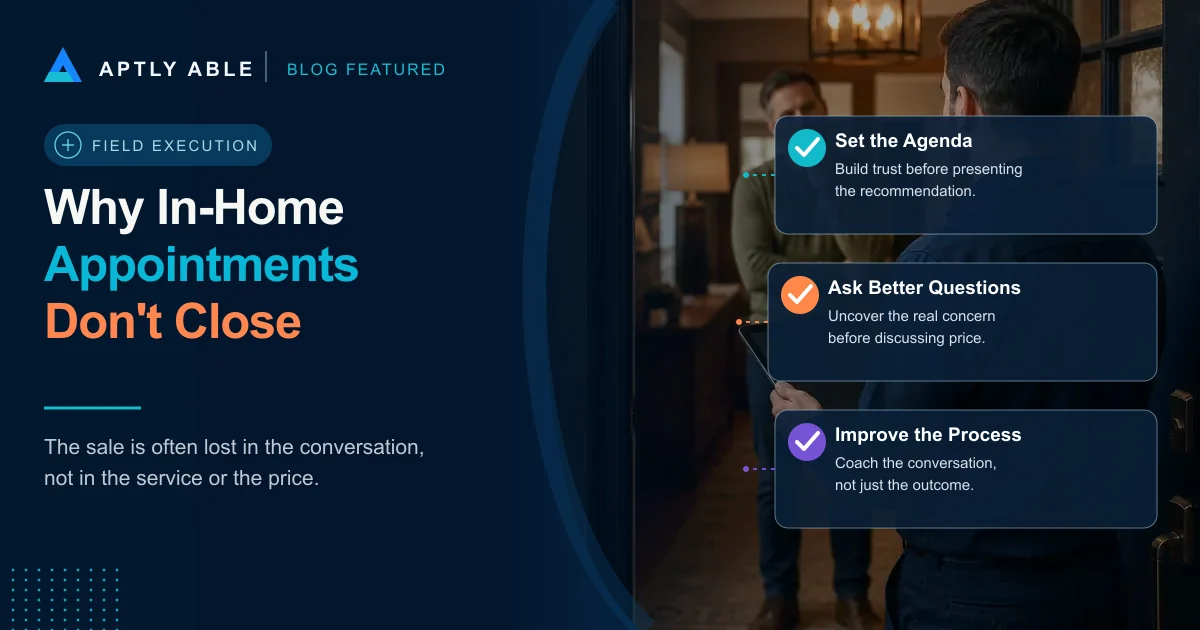
The first is a failure of the conversation in the home. The tech or comfort advisor is technically competent. They diagnose the problem correctly. They present a solution. But somewhere in the conversation, trust does not get built the way it needs to. The customer feels like they are being sold to rather than advised. The recommendation gets presented in technical language the homeowner does not fully understand. The price comes out before the value has been established. The customer says they will think about it, and they mean it, because they are not sure they are making the right decision.
The second is a failure of follow-through after the visit. The appointment goes well. The customer is genuinely interested. They are not saying no, they are saying not yet. But not yet requires something from the business. It requires a follow-up call at the right time, from the right person, with the right information. In most companies, that follow-up either does not happen or happens so generically that it does not move the customer any closer to a decision.
The third is a failure of information transfer. The CSR who took the booking call learned things about the customer. The customer mentioned they had been having the problem for two summers. They said they were worried about the cost. They mentioned they had already gotten one other quote. None of that made it to the tech who showed up at the door, because there is no structured way to transfer it. The tech walks in cold, builds the relationship from scratch, and loses ground they should never have had to give up.
The fourth is a failure of visibility. The manager does not know which of these things happened. They see that the appointment did not convert, but they do not know if it was the conversation in the home, the follow-up, the information transfer, or something else entirely. So they cannot coach the specific behavior that would have changed the outcome. The same mistakes repeat because there is no feedback loop that makes them visible.
The Visibility Problem Is the Root of the Others
Of the four failure modes above, the fourth one is the most important to address first. Not because the others do not matter, but because fixing them requires seeing them clearly.
You cannot coach a tech on how they present recommendations in the home if you do not know what they are actually saying. You cannot fix an information transfer problem if you do not know what information the customer shared and whether it made it to the field. You cannot improve follow-up if you do not know what was said at the end of the appointment that should have shaped how the follow-up was handled.
Most service businesses are managing their field performance almost entirely on indirect signals. Revenue numbers. Close rates. Job count. Customer satisfaction scores. These are all outcomes. They tell you what happened, but not why, and not what specifically to change.
Real improvement in field performance requires getting closer to the actual conversations. What did the tech say when the customer raised a concern about price? How did they handle the moment when the customer said they wanted to get another quote? What did they promise at the end of the visit, and is there a record of it anywhere?
Without answers to those questions, coaching stays general. General coaching changes behavior slowly, if at all. And the close rate problem stays stuck at roughly the same place it has always been.
What Changes When You Close the Visibility Gap
When service businesses get real visibility into what is happening in their field appointments, a few things tend to happen quickly.
Coaching gets specific. Instead of telling a tech to do a better job handling objections, a manager can sit down with a recording of a specific conversation, identify the exact moment where the tech agreed with the customer's hesitation rather than exploring it, and have a targeted conversation about what to do differently next time. Reps respond to that kind of feedback in a completely different way than they do to general instruction. It is concrete. It is fair. It is tied to something real that they actually experienced.
Patterns become visible. When you can see what is happening across dozens of field appointments rather than just the handful a manager happened to follow up on, the patterns that are costing the most revenue become obvious. The same objection coming up in the same type of appointment. A specific rep who is strong on residential calls but struggles with commercial. A recurring gap between what gets promised in the home and what gets communicated back to the office afterward. These patterns exist in every service business. Without visibility, they stay invisible. With it, they become very addressable.
Follow-up gets better. When there is a clear record of what happened in the appointment, the follow-up can be built around that record. The person calling the customer back knows what was discussed, what the customer was concerned about, and what the next logical step is. That is a very different conversation than a generic "just following up on your estimate" call, and it converts at a much higher rate.
Dispatch gets smarter. When managers have accurate, ongoing data on how each tech or comfort advisor actually performs in the field, not self-reported, not based on likability in team meetings, but based on what happens in actual appointments, they can start making better decisions about who runs which kinds of calls. Putting the right person on a high-value replacement opportunity instead of whoever happens to be geographically closest can have a significant impact on close rates and revenue per appointment.
What This Looks Like in Practice
The service businesses that have addressed this problem well have not done it by hiring better people or spending more on training. They have done it by building better feedback loops.
They capture what happens in field appointments in a structured way. They review that information regularly and use it to coach specific behaviors. They transfer relevant context from the booking call to the field before the appointment starts. And they have a clear, consistent follow-up process that runs after every appointment based on what actually happened, not on what the tech remembers or what gets entered into the CRM.
The result is not a dramatic overnight change. It is a steady improvement in close rate that compounds over time. A few percentage points in the first month. A few more in the second. And because the feedback loop keeps running, the improvement does not plateau the way most training initiatives do.
For a business doing serious volume in HVAC, plumbing, or other in-home service categories, that kind of sustained improvement in field close rate is one of the most valuable things it can build.
FieldSense by Aptly Able is built to close this visibility gap. It captures what happens during field appointments, structures the information in a way managers can act on, and helps teams follow through consistently after every visit. If your close rate on in-home appointments is not where it should be, that is usually the right place to start looking.
Learn more at aptlyable.com/fieldsense, or start with a free Revenue Recovery Audit at aptlyable.com/revenue-recovery-audit to find out where your business is leaving the most on the table.
In-Home Appointment Close Rate FAQs
Why do in-home service appointments fail to close?
Common causes include weak trust-building during the visit, poor follow-up, lost context between the booking call and the field, and limited visibility into the conversation managers need to coach.
How can a home-service company improve its appointment close rate?
Capture what happens during appointments, coach specific behaviors, transfer customer context before the visit, and run a consistent follow-up process based on the actual conversation.
Why is field-performance visibility important?
Outcome metrics show what happened, but visibility into field conversations helps managers understand why it happened and what behavior should change.
What information should pass from the CSR to the technician?
Useful context includes the customer's history with the problem, cost concerns, competing quotes, priorities, and details that can help the technician begin the visit informed rather than cold.
How does better appointment context improve follow-up?
A clear record lets the follow-up person address the customer's actual concerns, promises, and next step instead of making a generic estimate-check call.
What is FieldSense?
FieldSense is Aptly Able's field-performance system for structuring appointment information, supporting specific coaching, and improving follow-through after visits.
Recommended next reads
Related Aptly Able resources
- FieldSense See how Aptly Able turns field conversations into specific coaching and consistent follow-through.
- Revenue Recovery Audit Find where missed appointments, weak follow-up, and execution gaps are leaving revenue on the table.
- What Is Revenue Recovery? Learn how businesses recover revenue from opportunities they already have.