
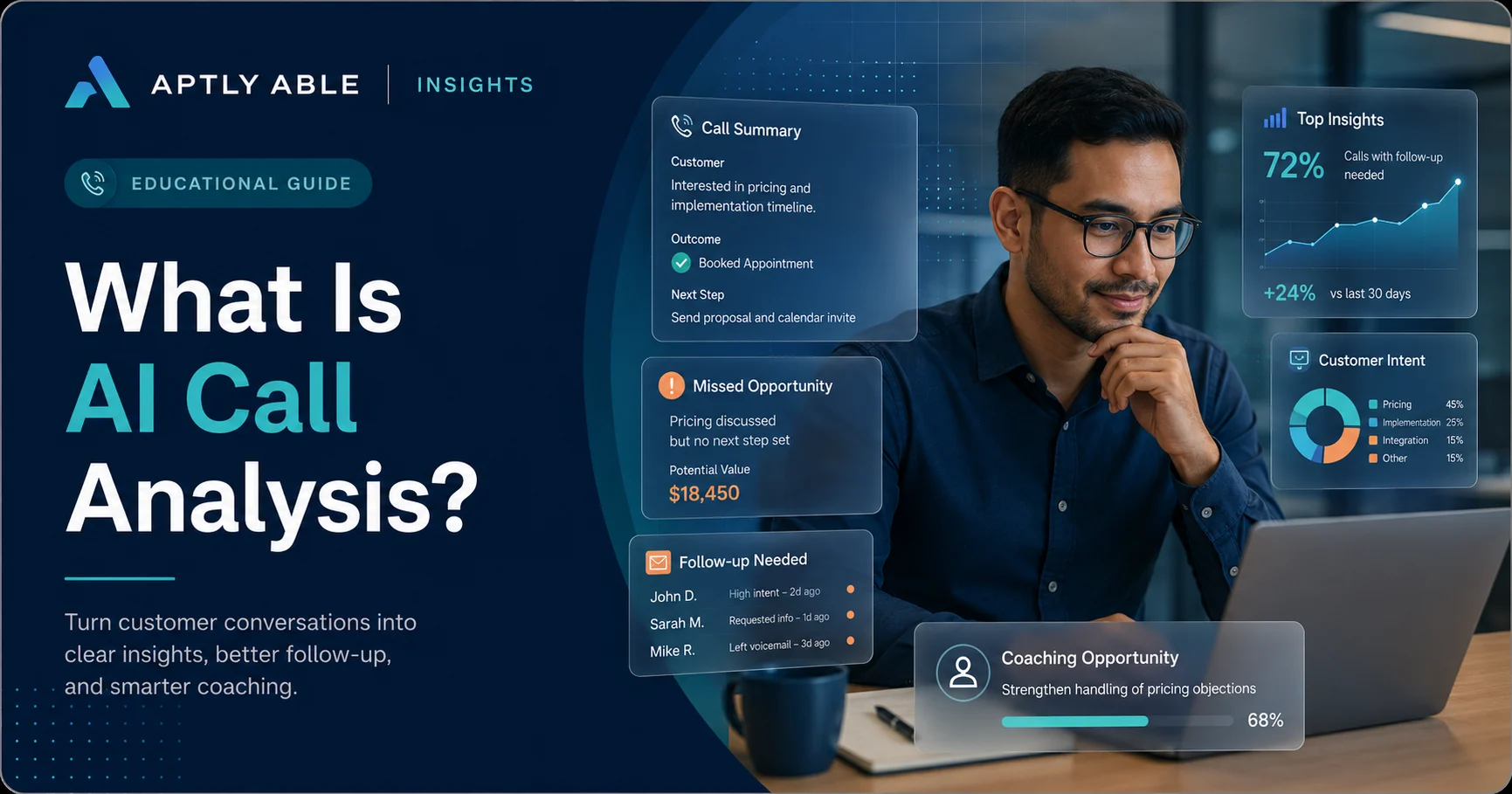
A lot of companies are hearing about AI from every direction right now.
Some of it is useful. Some of it is noise. And a lot of it sounds more complicated than it needs to be.
So here is the simple way to think about AI call analysis.
AI call analysis helps a company understand what is happening on the phones, where opportunities are being missed, and what needs to happen next.
That matters because for most companies, the phones are one of the most important parts of the business. Leads come in. Customers ask questions. Appointments get booked. Objections come up. Follow-up gets promised. Deals are won, lost, saved, or missed.
But most of that information disappears the second the call ends.
A manager might hear about a few calls. A rep might take notes. A customer might call back. Maybe a call gets reviewed later if there is a complaint or a training issue.
But most calls are never really seen.
That is the problem AI call analysis solves.
It gives managers a way to review every call, not just the few calls they happen to hear about. It helps show which calls went well, which calls broke down, which customers still need follow-up, and which missed opportunities can still be recovered.
A lot of companies think the answer is always more leads. More marketing. More ad spend. More campaigns. More calls coming in.
Sometimes that is true. But a lot of revenue is already sitting in the calls the company is getting right now.
It is sitting in the customer who asked a buying question but never got a clear next step.
It is sitting in the lead who was interested but did not get called back fast enough.
It is sitting in the customer who had an objection that could have been handled.
It is sitting in the appointment that should have been booked but was not.
It is sitting in the follow-up that was promised but never happened.
AI call analysis helps find those opportunities.
That is the real value.
It is not just about getting a transcript. A transcript is useful, but a transcript by itself does not fix the problem. A transcript tells you what was said. AI call analysis should help tell you what mattered, what was missed, and what needs action.
There is a big difference between summarizing calls and actually finding revenue.
A basic AI tool might tell you, "The customer called about pricing and asked about availability."
That is fine, but it is not enough.
A better AI call analysis system should help answer questions like: Was this a real opportunity? Did the rep ask for the appointment? Was the customer ready to move forward? Was there an objection? Was that objection handled well? Was follow-up promised? Did the follow-up actually happen? Could this deal still be saved? Does this rep need coaching? Is this same issue happening over and over?
That is where AI call analysis becomes valuable for a business.
It gives the company a daily recovery view and a bigger long-term coaching view.
The daily view is about speed.
These are the calls that need attention right now. These are the customers who may still be saved. These are the missed opportunities that are still fresh enough to recover. These are the follow-ups that need to happen before the customer moves on or calls someone else.
That daily view helps managers move quickly.
Instead of waiting until the end of the month to find out there was a problem, they can see it while there is still time to do something about it.
The monthly view helps a company understand the bigger patterns: what customers repeatedly ask for, where calls break down, which reps are converting well, which reps need coaching, which objections come up most often, and whether process issues keep showing up across multiple calls.
That information is extremely valuable because it turns the phones into a training and improvement system.
Most managers know they need to coach their team. The hard part is knowing exactly where to coach.
AI call analysis helps make that clearer.
Instead of coaching from memory, gut feel, or one bad call, a manager can coach from what is actually happening across the calls. They can see strong moments, coachable moments, and repeated patterns.
That is better for the manager, and it is better for the rep.
Good call analysis should not just be used to catch people doing something wrong. That is the wrong way to use it.
The best use is to help people get better.
If a rep is doing something well, that should be recognized and repeated. If another rep is struggling with a specific objection, that should become a coaching opportunity. If the whole team is missing the same type of follow-up, that is probably a process issue, not just a person issue.
That is why AI call analysis is not just a technology tool. It is an operations tool.
It helps sales, customer service, marketing, training, and management all see the same reality.
Marketing can see what kinds of leads are actually turning into conversations. Sales can see where deals are being missed. Customer service can see where customers are getting confused or frustrated. Managers can see who needs help and where. Ownership can see where revenue is leaking out of the business.
For a long time, companies have had call recordings, but call recordings are not the same thing as call intelligence.
A recording is raw material. AI call analysis turns that raw material into something useful.
It helps answer the question every business should be asking: where are we losing opportunities in the customer journey right now?
Because once a company knows where the loss is happening, it can fix it.
If the database is the biggest opportunity, the company may need better outreach. If calls are where revenue is being missed, the company needs better call analysis and recovery. If appointments are being run but not closed, the company may need better field visibility and coaching.
But the first step is seeing the problem clearly.
That is what AI call analysis does for the phones.
It helps a company stop guessing. It helps managers stop relying on a tiny sample of calls. It helps teams recover more of the revenue they already have. It helps reps improve faster. And it helps the business understand what customers are actually saying every day.
At Aptly Able, that is how we think about CallSense.
A lot of AI tools stop at summaries. CallSense is built to go further.
The goal is to review every call, find the low-hanging fruit, identify missed opportunities, show broken follow-up, and give managers something they can act on right now.
The daily report helps recover deals that can still be saved. The bigger monthly view helps improve coaching, tighten the process, and increase conversion over time.
AI call analysis is not just about listening to calls.
It is about finding the revenue, coaching opportunities, and process issues that are already sitting inside the calls a company is getting every day.
And when a company can see that clearly, it can start turning more missed opportunities into booked work.
Recommended next reads
Related Aptly Able resources
- CallSense See Aptly Able's call intelligence solution for reviewing calls and finding missed opportunities.
- Why Reviewing 1% of Customer Calls Is No Longer Enough Learn why small call samples miss patterns that broader AI-assisted review can uncover.
- Missed Call Recovery See how missed phone demand can turn into recovery action and coaching insight.
Helpful external reading
- Google Cloud: Customer Experience Insights and Quality AI Google Cloud's documentation explains how CX Insights detects and visualizes patterns in contact center conversation data.