
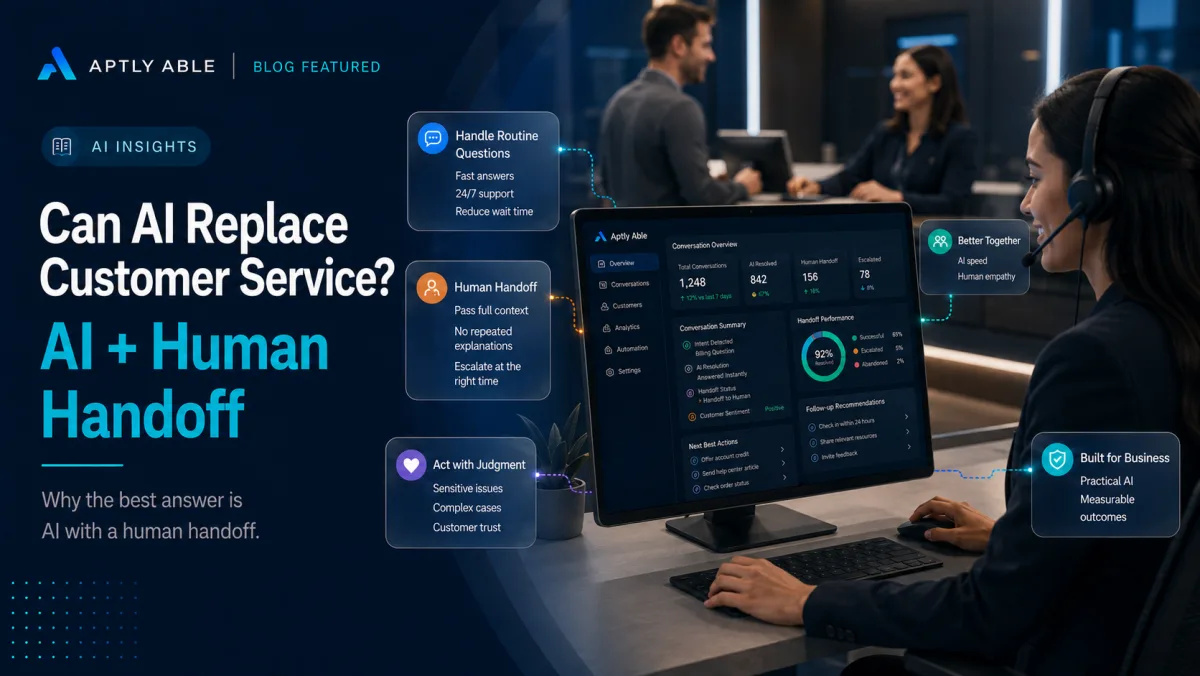
Can AI Replace Customer Service Representatives?
AI can replace certain customer-service tasks. It can answer common questions. It can check business hours, provide basic product information, confirm appointments, collect contact information, route requests, create support tickets, send reminders, and help customers complete straightforward transactions.
Those are real capabilities, and they can create real value. AI can give customers immediate answers when employees are busy. It can help a company respond after hours. It can reduce the time representatives spend searching for information. It can summarize customer history before a person joins the conversation. It can also help identify which conversations require urgent attention.
But handling part of the work is not the same as replacing the entire customer-service function.
Customer service includes situations that are emotional, unclear, sensitive, expensive, unusual, or difficult to resolve. It includes customers who do not know how to explain what they need. It includes exceptions that do not fit neatly inside the company’s process. It includes moments when someone needs to take responsibility instead of simply providing another answer.
AI is getting better at language. That does not mean it understands every customer, every business, or every consequence.
Customers Want Speed, but They Also Want to Feel Understood
There is an important tension in customer service. Customers want fast answers. They do not want to wait on hold, repeat their information, leave multiple voicemails, or spend twenty minutes trying to find a simple answer. AI can help tremendously with those problems.
But customers also want to feel understood. SurveyMonkey reported in 2026 that 79% of Americans preferred interacting with a human rather than an AI agent. Respondents said humans were more likely to understand their needs and provide thorough explanations.
That does not mean customers reject every use of AI. Most people are perfectly willing to use automation when it works. They will use an online tool to check an order. They will interact with an automated system to confirm an appointment. They may use a chatbot to find store hours or reset a password.
The frustration usually begins when the situation becomes more complicated and the system refuses to recognize it. The customer explains the problem. The AI provides a generic answer. The customer explains it again. The AI sends the same answer in slightly different words. Then the customer asks for a person and discovers that there is no clear way to reach one.
At that point, the problem is no longer whether the AI gave a technically correct response. The problem is that the customer feels trapped.
Where AI Customer Service Works Well
The best uses for AI customer service usually have three characteristics: the request occurs frequently, the correct outcome is clearly defined, and the risk of getting it wrong is relatively low.
For example, AI may be able to handle questions such as:
- What time do you open?
- Do you serve my area?
- Has my order shipped?
- Can I reschedule my appointment?
- What information should I bring?
- Which department handles this issue?
- Can someone call me tomorrow?
- Did you receive my request?
AI Can Support the Employees Handling More Complicated Situations
AI can retrieve account history, summarize previous conversations, identify promises made to the customer, suggest relevant information, and create an organized record of what happened.
Microsoft describes this type of AI assistance as a way to help service representatives find resources faster, handle cases more efficiently, and automate time-consuming work.
That is an important point. AI does not have to speak directly to the customer to improve customer service. Sometimes the best use of AI is behind the employee.
Where AI Customer Service Starts to Break Down
Customer conversations do not always follow a clean script. A customer may call about a billing question but reveal that the real issue is a repeated service failure. A homeowner may ask about repair pricing when they are actually trying to determine whether they need to replace an entire system. A customer may sound angry when they are really worried that nobody is taking responsibility.
The stated question and the real problem are not always the same. This is where human judgment becomes important.
AI customer service is more likely to struggle when:
- The customer’s situation is unusual.
- Several issues are connected.
- The available information conflicts.
- The customer is emotional or frustrated.
- A policy exception may be appropriate.
- The issue involves significant financial consequences.
- The company made a mistake.
- The correct answer requires judgment rather than a rule.
- The customer relationship itself is at risk.
Human Judgment Still Matters
AI may be able to recognize some of these situations. But recognizing that a customer is angry is different from knowing how the company should repair the relationship.
Recognizing that a customer asked for a refund is different from deciding whether an exception is justified. Recognizing a sales objection is different from understanding the personal concern behind it.
Those are moments where experience, accountability, and empathy matter.
The Human Handoff Is Part of the AI System
A lot of companies treat human escalation as evidence that the AI failed. That is the wrong way to look at it.
A good AI system should know when it has reached the edge of its responsibility. The human handoff is not a backup plan that gets added later. It should be designed into the customer experience from the beginning.
Salesforce has emphasized that a successful AI-to-human handoff should preserve the customer’s context, conversation history, and relevant data. The customer should not have to start the entire conversation again simply because a person became involved.
That sounds obvious. But most people have experienced the opposite. They enter their account number into an automated system. They explain the issue to a chatbot. They answer several questions. Then a representative joins the conversation and asks for the account number again.
That is not an intelligent handoff. It is two disconnected systems making the customer do the work.
A useful handoff should tell the employee:
- Who the customer is.
- Why the customer contacted the company.
- What the customer has already explained.
- What answers have already been provided.
- What actions have been attempted.
- Why the AI escalated the interaction.
- What the employee may need to do next.
The Conversation Should Continue, Not Restart
The customer should feel as though the conversation continued. They should not feel as though it restarted.
AI Should Handle Volume. People Should Handle Importance.
There is a simple way to think about the division of work. AI is very good at volume. People are very good at importance.
AI can review thousands of conversations. It can answer repeated questions consistently. It can operate outside normal business hours. It can identify patterns that no manager would have time to find manually.
People can understand exceptions. They can weigh consequences. They can reassure a worried customer. They can take responsibility. They can recognize when preserving the relationship matters more than following the standard process exactly.
The strongest customer-service operation uses both. AI handles the repetitive work, organizes the information, identifies what matters, and gives employees a clearer starting point. People step in when the situation requires judgment, trust, creativity, empathy, or accountability.
That is not a compromise between technology and people. It is a better operating model.
AI Can Improve Human Customer Service Without Talking to Customers
Some of the most useful applications of AI happen after a conversation or behind the scenes.
Imagine that a company receives hundreds or thousands of calls every month. Managers cannot listen to every call. Representatives cannot remember every commitment. Important details get buried in recordings, CRM notes, inboxes, and task lists.
AI can review those conversations and identify:
- Customers who showed buying intent but did not move forward.
- Appointments that should have been booked.
- Follow-up that was promised but never completed.
- Customers who may be frustrated or at risk.
- Questions that representatives struggle to answer.
- Objections that appear repeatedly.
- Employees who need coaching in a specific area.
- Strong conversations that could be used as training examples.
AI Helps Teams See What Would Otherwise Be Missed
In that model, the AI is not replacing the representative. It is helping the representative and the manager see what would otherwise be missed.
That may be more valuable than having the AI answer the call itself.
AI Customer Service Still Needs Clear Business Context
An AI system cannot provide dependable customer service if it does not understand the company. A general AI model may know how customer service usually works. That is not the same as knowing how your customer service should work.
The system may need accurate information about:
- Products and services.
- Pricing and financing.
- Service areas.
- Scheduling rules.
- Warranties.
- Return policies.
- Escalation procedures.
- Available employees.
- Customer history.
- Approved promises.
- Legal or compliance requirements.
AI Needs Boundaries as Well as Context
It also needs boundaries. What can the AI say? What can it change? Can it issue a refund? Can it schedule an appointment? Can it make a pricing commitment? Can it contact a customer without approval? When must it involve an employee?
An AI system that sounds natural but lacks company context can confidently provide the wrong answer. That is worse than admitting uncertainty.
The goal should not be to make the AI sound human at any cost. The goal should be to help the customer reach the correct outcome.
How to Decide What AI Should Handle
Businesses should not begin by asking how many customer-service jobs they can automate. They should begin by reviewing the work.
Look at the conversations customers are already having with the company. Which questions appear repeatedly? Which requests are simple and predictable? Where are customers waiting unnecessarily? Where are employees spending time searching for information? Which conversations require a manager? Where do customers become frustrated? Which commitments get lost after the interaction ends?
Then divide the work into three categories.
1. AI Can Handle It
These are routine requests with a clear answer and limited risk. The AI may be able to complete the interaction without employee involvement.
2. AI Can Assist With It
These situations still need a person, but AI can collect information, summarize the history, retrieve relevant details, recommend next steps, or prepare the employee before the handoff.
3. A Person Should Own It
These are sensitive, unusual, consequential, or relationship-driven situations where human judgment should remain central.
That framework is more useful than trying to automate an arbitrary percentage of customer service.
How Should Businesses Measure AI Customer Service?
An AI customer-service system should not be judged by how many conversations it prevents from reaching an employee. That number can be misleading.
A system can create a high “containment rate” by making it difficult for customers to escape. That does not mean it solved their problems.
Businesses should measure outcomes such as:
- Was the customer’s issue actually resolved?
- How long did resolution take?
- Did the customer have to repeat information?
- Was the interaction escalated at the correct time?
- Did the employee receive useful context?
- Were appointments successfully booked?
- Were promised follow-ups completed?
- Did customer satisfaction improve?
- Did repeat contacts decrease?
- Did employees save meaningful time?
- Did fewer opportunities fall through the cracks?
Measure Better Outcomes, Not Just More Automation
Salesforce reported in 2026 that service professionals using AI agents showed strong confidence in expanding their use, while its broader service research projects AI will resolve a growing share of service cases.
The technology is clearly moving forward. But the right measurement is still whether the customer and the business received a better outcome.
Will AI Eventually Replace Customer Service?
AI will replace more customer-service tasks. Some positions will change. Some workflows will require fewer manual steps. Some customer requests may eventually be handled almost entirely by AI.
But customer service is not one task. It is a collection of questions, decisions, transactions, relationships, exceptions, promises, and problems.
The routine parts will become increasingly automated. The human parts will become increasingly important.
As AI handles more basic interactions, the situations reaching employees may become more complicated. Representatives will need stronger judgment, better information, and more authority to solve problems.
That means companies should not stop investing in their people. They should prepare people for higher-value work.
The future customer-service representative may spend less time repeating account information and more time resolving exceptions. Less time documenting calls and more time helping customers. Less time searching through systems and more time making decisions.
That is a better use of human ability.
The Best Customer Service Does Not Make Customers Choose
Customers should not have to choose between fast AI and helpful people. They should receive both.
They should get an immediate response when the request is simple. They should reach a capable person when the situation becomes complicated. The information should move with them. The company should know what was promised. And someone should remain accountable for the outcome.
At Aptly Able, that is how we think about practical AI. AI should help businesses see more conversations, respond faster, identify what needs attention, and prevent important opportunities from disappearing.
But the purpose is not to remove people from every interaction. The purpose is to make sure people are involved where they create the most value.
AI can provide speed. AI can provide scale. AI can provide visibility. People provide judgment, empathy, responsibility, and trust.
The companies that combine those strengths will deliver better customer service than companies that rely entirely on either one.
The goal is not AI instead of people. The goal is AI and people working together so the customer gets the right help at the right time.
Frequently Asked Questions About AI Customer Service
Can AI completely replace customer service representatives?
AI can automate many routine customer-service tasks, but it should not completely replace representatives in situations requiring judgment, empathy, accountability, exceptions, or relationship management.
What can an AI customer service agent do?
An AI customer service agent can answer common questions, retrieve information, schedule appointments, collect customer details, route requests, summarize conversations, update records, and complete certain predefined transactions.
When should AI transfer a customer to a human?
AI should transfer the customer when it is uncertain, the issue is sensitive or complex, the customer requests a person, an exception may be required, the customer is becoming frustrated, or the decision carries meaningful financial or relationship risk.
What is an AI-to-human handoff?
An AI-to-human handoff occurs when an automated system transfers a customer interaction to an employee. A good handoff includes the customer’s history, the current conversation, actions already attempted, and the reason for escalation.
Do customers prefer AI or human customer service?
Preferences depend on the situation. Customers often accept automation for simple and routine requests, but recent consumer research shows a strong preference for people when customers need understanding, detailed explanations, or help with complicated problems.
How can AI help human customer service representatives?
AI can summarize customer history, locate information, document conversations, identify sentiment, recommend relevant resources, create follow-up tasks, and alert employees to urgent or unresolved issues.
What is the best AI customer service strategy?
The best strategy gives AI responsibility for repetitive, predictable, low-risk work while preserving clear access to human employees for complex or important situations. The handoff should carry the customer’s context so the interaction continues without unnecessary repetition.
Recommended next reads
Related Aptly Able resources
- What Are AI Agents? Learn how practical AI agents analyze business signals, support workflows, and move work forward.
- AI Should Make People Better, Not Replace Them Explore Aptly Able’s human-centered approach to using AI for better judgment and performance.
- Explore CallSense See how AI call analysis surfaces unresolved issues, missed opportunities, follow-up gaps, and coaching needs.
- Request a Revenue Recovery Audit Find customer conversations, follow-up failures, and recoverable revenue already inside your business.