If you run a customer service team, you have probably heard some version of this before: most traditional QA programs only review a very small percentage of calls. For a long time, that felt fine. You would spot-check a handful of recordings, grade a few agents, run a calibration session, and call it a day.
But here is the thing: that approach was built for a different era. And if you are still doing it today, you are almost certainly missing what is actually happening on your phones.
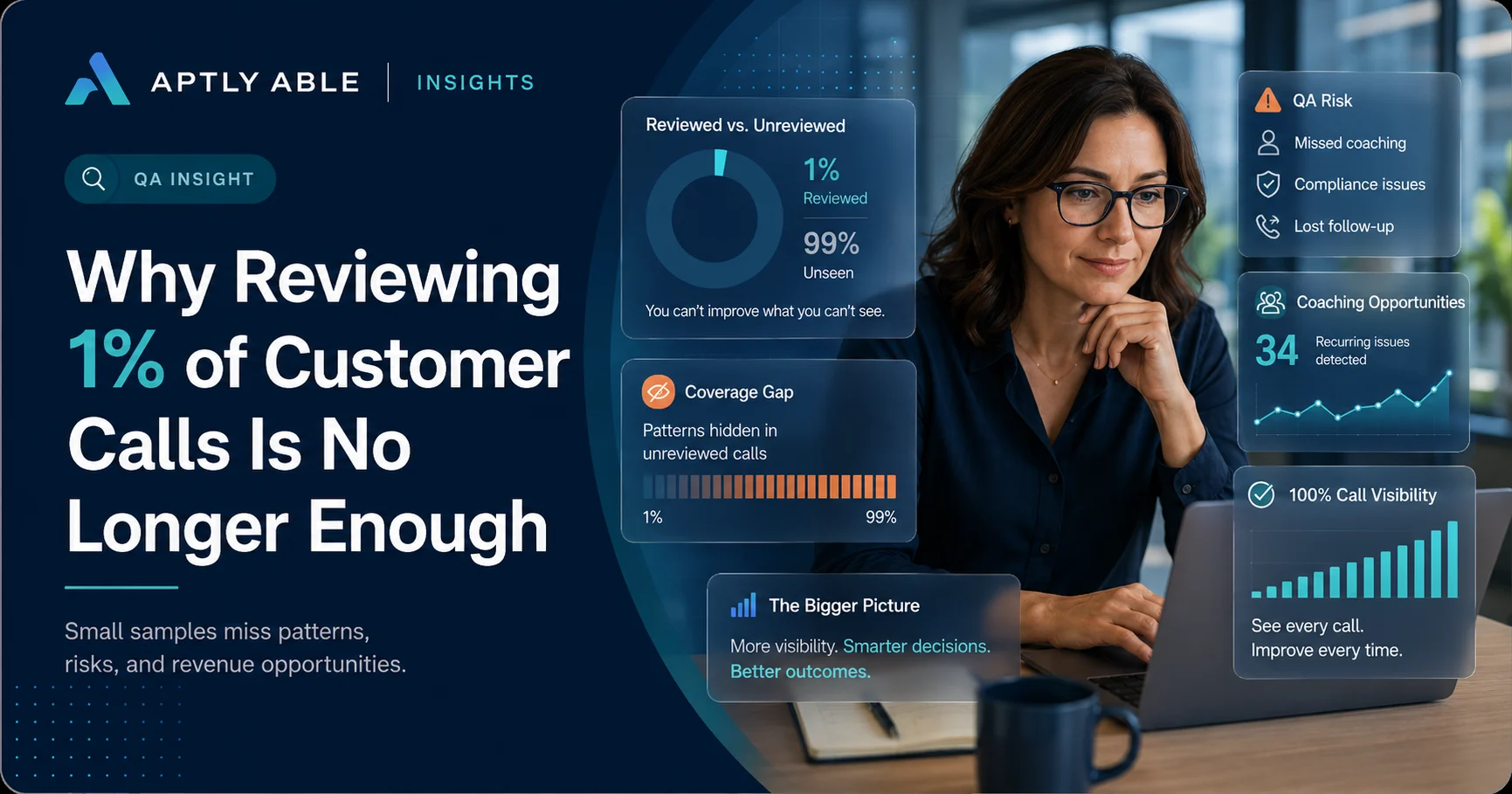
Say your team handles 10,000 calls a month. If you are reviewing 1%, that means you are listening to 100 of them. That sounds reasonable until you realize what you are not seeing.
Those 9,900 unreviewed calls contain real customer frustrations, agent mistakes, missed booking opportunities, compliance risks, price objections, broken follow-up, and coaching moments you may never find out about. Not because nothing went wrong, but because nobody was ever going to listen to them.
And the 100 calls you did review were probably not as random as you think. QA teams often pull calls based on length, flags, complaints, call type, or whoever is due for a review. That can be useful, but it is not always a representative sample. It is a small slice of what your team is actually doing.
When your insights are built on 1% of the data, your decisions are built on 1% of the data too. That should feel uncomfortable.
The problems with low-coverage QA are not just theoretical. They show up in predictable, costly ways.
You miss emerging issues until they are already big. A new product launches, a new promotion starts, or a new financing option gets introduced, and suddenly agents are fumbling the same question over and over. With low call coverage, you might catch this three weeks later when a manager hears it by accident. By then, hundreds of customers may have already had a confusing or frustrating experience.
Your best agents can look average and your struggling agents can look fine. When you only review a handful of calls per agent each month, you are essentially rolling the dice. A great agent who had two rough calls in the sample may look worse than a struggling agent who happened to get a few easy calls.
Compliance risks hide in the gaps. If an agent is going off-script, skipping a required step, or saying something they should not say, there is a good chance it is happening in the calls you are not reviewing. The first time you find out might be from a customer complaint or a legal issue.
You cannot see patterns, only incidents. One bad call is an incident. Twenty calls with the same root cause is a pattern. QA programs that sample too lightly can surface individual problems. They are much weaker at finding patterns, because patterns require enough data to recognize them.
That matters because patterns are where the business improvement usually lives. If customers keep asking the same pricing question, that might be a website issue. If reps keep missing the close after the same objection, that is a coaching issue. If follow-up keeps breaking after appointments are requested, that is a process issue. But you cannot fix what you cannot see.
The obvious response is: we would love to review more calls, but QA is already stretched thin. And that is completely valid.
Manual call review is slow when it is done well. A single QA analyst can only review so many calls in a day if they are being thorough. Scaling from a tiny sample to meaningful coverage would require more people, more time, and more budget than most teams have available.
That is why many teams stay stuck with low coverage. Not because they do not understand the risk, but because the alternative has always seemed too expensive or too difficult to manage.
Teams that move beyond low-coverage QA start to see a fundamentally different picture of their operations.
When you can analyze a meaningful portion of your calls, and ideally all of them, you stop guessing and start knowing. You know which agents are struggling with specific scenarios. You know which products or services are generating the most confusion. You know when a policy change created friction in customer conversations. You can see which call types have the highest handle times and understand why.
More coverage also changes how coaching works. Instead of one manager reviewing a few calls and giving general feedback, you can give every agent specific, timely feedback based on what they are actually doing. That is the kind of coaching that moves numbers.
It also helps recognize what is working. A strong call should not disappear just because nobody happened to review it. If a CSR handled a difficult objection well, that example can become training for the rest of the team. If one rep consistently gets customers to take the next step, managers can study what that person is doing and help the whole team improve.
Calls are a goldmine of customer signals. What are people confused about on your website? What objections come up most in sales calls? What are customers asking about that you do not have a good answer for yet? Where are customers getting stuck before they book?
That information is sitting in your call recordings right now. If you are only reviewing a small percentage of calls, most of it will never reach anyone who can act on it.
The reason most teams are stuck with low call coverage is not a lack of ambition. It is a capacity problem.
AI call analysis changes that model by reviewing calls automatically and surfacing the ones that need human attention. That does not mean managers stop managing or QA teams stop using judgment. It means the system does the heavy lift of reviewing the full call volume, identifying patterns, and pointing the team toward the moments that matter most.
Instead of a QA team spending its day trying to manually find the needle in the haystack, AI can help show where the needles are. The team can then focus on coaching, escalation, process improvement, and customer recovery.
That is a much better use of people.
The best use of AI is not to replace the human judgment inside a QA process. It is to give that judgment better information. Better visibility creates better coaching. Better coaching creates better customer experiences. And better customer experiences usually create better business outcomes.
This is the specific problem CallSense was built to help solve.
CallSense is designed to analyze calls automatically and score them against the criteria that matter to your business, such as call quality, customer sentiment, script adherence, missed follow-up, booking opportunities, and compliance. The goal is not to bury managers in more data. The goal is to surface the calls, trends, and opportunities that actually need attention.
That means coaching can become more targeted. Compliance reviews can become more proactive. Missed opportunities can be identified while there is still time to recover them. And leadership can get a more accurate view of what customers are experiencing when they call in.
If your team is still operating from a tiny sample of calls, the first step is not to blame the team. The first step is to get better visibility.
Once you can see what is happening across every call, you can coach better, recover more missed opportunities, and make better decisions about the customer experience.
That is what CallSense is built around.
Recommended next reads
Related Aptly Able resources
- CallSense Use AI call analysis to identify missed follow-up, coaching needs, and customer experience gaps.
- What Is AI Call Analysis? Start with the basics of how AI call analysis turns recordings into actionable insight.
- Revenue Recovery Audit Audit where revenue is being lost across calls, follow-up, and customer conversations.
Helpful external reading
- McKinsey: AI mastery in customer care McKinsey discusses how generative AI can help automate quality analysis across live interactions and improve contact center QA coverage.